Women's Soccer
Dylan Buell / Getty Images
FORT LAUDERDALE, Fla. — What’s the secret to winning a seven-a-side tournament when $2 million is on the line?
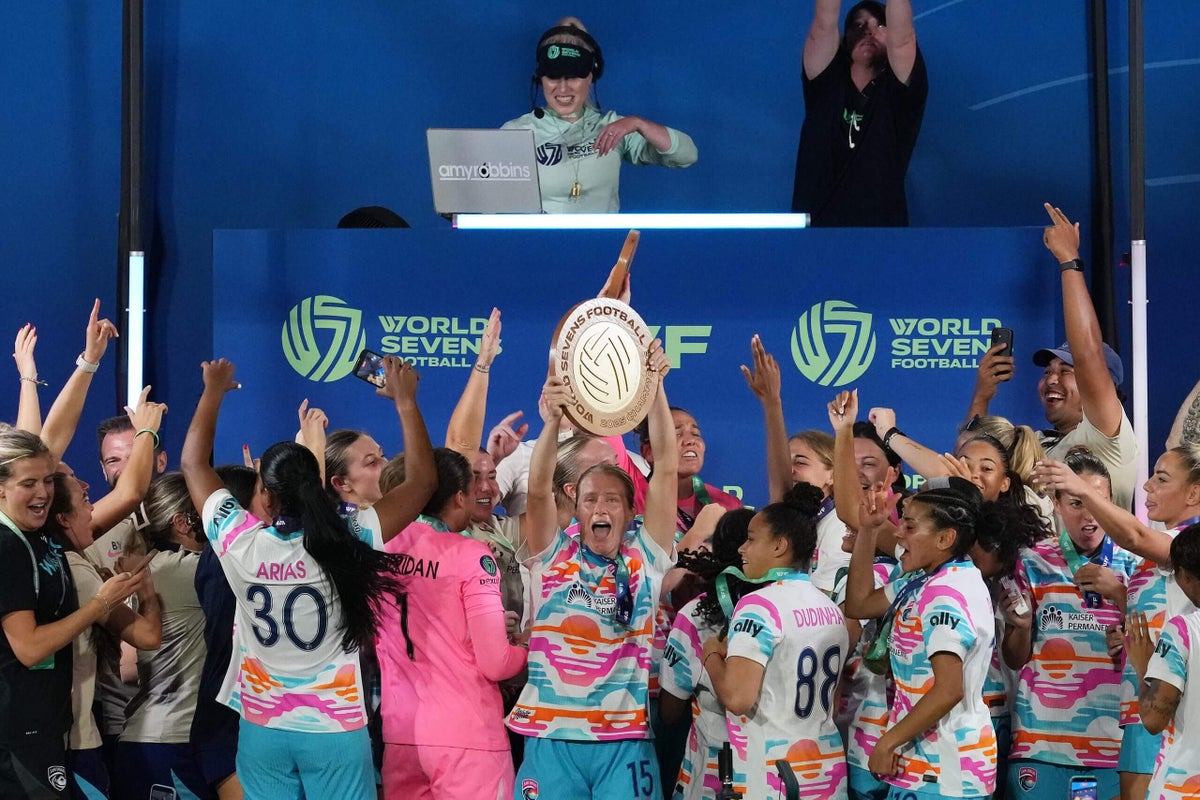
“Be brave,” San Diego Wave midfielder Gia Corley said after her club won the second World Sevens Football competition on Sunday evening, beating Tigres 3-0 to cap off an impressive campaign. The Wave went undefeated in their ascent to the podium, scoring a total of 14 goals and conceding three. Corley was awarded Breakout Player of the tournament.
Advertisement
Her advice was as simple as the Wave were flamboyant in the latest iteration of the three-day, seven-vs-seven tournament.
Following the inaugural event in Portugal this May that featured all European teams, this World Sevens was an exaltation of its greatest strength: the communion of cultures not only across countries but continents, with an invitation to bring their own style of play into close quarters. The Wave play in the National Women’s Soccer League (NWSL) in the U.S., but their World Sevens roster featured players who also represent Germany, Sweden, Brazil, France, Canada, Colombia, and Bosnia and Herzegovina.
“If I wanted to play in the Champions League, I’d have to play for a European team. You’re never going to see a U.S. team or South American team play in that format,” said former England Lioness and WSL player Anita Asante, who serves on the World Sevens advisory board, before the start of the tournament.
“Whereas so many more teams can participate and bring their own cultural elements to this experience as well and open up a whole new fanbase and fun experience because now everyone gets to see what it’s like.”
“From South American teams and their style — and the evolution of the playing styles and trends as well that we don’t always get to see because we sometimes get really centered in one sort of format or one place in the world that we’re experiencing the game from,” she continued. “So just opening up that whole lens as well has been really powerful for the players and us.”
Since its inception last year, when Gotham FC minority owner Jennifer Mackesy and her husband, Scott, made a personal commitment to sourcing $100million over five years, World Sevens has been marketed as a service for the social-media-obsessed. Soccer’s typical 90-minute matches have been chopped down to half an hour, the fields are split in two (the World Sevens pitch is roughly half the size of a traditional, FIFA-regulated field), and there are rolling substitutions and no offside rule.
Advertisement
There’s an irony to this approach: the tighter parameters result in an abundance of flashy, shareable clips on TikTok and Instagram, but witnessing the tournament in person turns mindless scrolling into a liability. In fact, try to avoid blinking at all during World Sevens altogether — you could miss what makes it special.
Take, for instance, the game-winning goal that Brazilian club Flamengo scored against the NWSL shield-winning Kansas City Current in the tournament’s opening match. Cristiane, a 40-year-old Brazilian forward with two decades of global success, received a ball off a throw-in with her hip and flicked it with her heel to assist Glaucia, who twerked to celebrate the goal.
“It’s a fast-paced game, but it’s my style of game,” Glaucia told The Athletic after that match. “Using my talents of ball control and getting into the game, playing as a team, and just enjoying ourselves.”
Flamengo’s flair wasn’t only in their attack. They were the only team in the competition to occasionally employ an outfield player as their ’keeper when they were hunting a goal.
When they were down 2-1 against AFC Toronto of the newly formed Northern Super League (NSL) with 45 seconds to go on Saturday, defender Monalisa Belem, playing as ’keeper for Vivi Holzel, dribbled the ball into their attacking half and shot a low, driven ball on frame. Toronto were unable to clear it and conceded an equalizer.
“We did what we could,” Holzel said of Monalisa’s ’keeper swap, a knowing smile spread across her face. “In Brazil, we train a lot in futsal, so they are used to (it).”
Flamengo won that game on penalties, which are played sudden-death style at World Sevens (as opposed to a best-of-five format). After the final whistle, the Brazilian side celebrated as if the $2 million had already hit their bank accounts, spraying their water bottles and dancing with supporters on the sidelines.
Advertisement
“Today we won. We don’t know the next game, so we are enjoying every step to make this happen because the competition is like that,” Holzel said. “We have to enjoy.”
Staying present and loose appears to be another ingredient in the secret sauce of World Sevens.
The players with standout performances were those for whom World Sevens looked like a return to simpler times, when mistakes were welcomed as opportunities to discover something new, improvisation was rewarded, and personality on the pitch was seen as an enhancement rather than a hindrance.
Few embodied that more than Tigres winger Maria Sanchez, who won the Golden Boot and Golden Ball awards with six goals and two assists.
“I grew up playing with boys playing small-sided (games) for hours, so I think a tournament like this suits me very well and it takes me back to my childhood days,” Sanchez said Saturday.
For others, the fast pace and fluidity required more adjustment, and the film from the first World Sevens and its all-European lineup could only help so much.
“We used a lot of the video for the structure and a little bit of the tactics, but I think we knew this was gonna be a different style of play,” San Diego Wave assistant coach Becki Tweed said of the team’s preparation. “When you see the South American teams play, they’re really smart in how they use their body, they have really good knowledge of space, and I think those are the things that vary a little bit from the European game.”
The requirements of the small-sided tournament also enlightened the coaching staff about their own roster. “Which is fun, because you think you know them until you put them in a new challenge,” Tweed added.
The format also exposed some teams that struggled to unwind on the pitch. The Current, despite their superlative season in the NWSL, failed to advance from the group stage against Flamengo, Toronto, and Tigres. Star players such as league MVP Temwa Chawinga, Michelle Cooper, and Claire Hutton were absent either due to injury or the need for rest, and were replaced by academy players.
Advertisement
The World Sevens organizers built off the success of their first event earlier this year, but they also had to account for key differences.
In May, the competition took place in Estoril, Portugal, in the days leading up to the Champions League final, just 30 minutes away in Lisbon. Fans needed only to extend their trip by a few days to enjoy both. This time around, not only was World Sevens without the proximity of a major competition to drum up support and publicity, but it wound up competing with Art Basel in Miami and Inter Miami’s MLS Cup final win (which they hosted) for attention that weekend. Attendance on Friday was scant but peaked on Saturday when each team played twice.
In the first edition, the fan zone and field were in separate locations, hindering the flow of traffic between matches. That issue was resolved at Beyond Bancard Stadium, but the foosball tables, sign-making stations, and World Sevens-branded claw machines were lonely throughout the weekend as many of the kids in attendance were competing in the Rising Sevens youth tournament behind the stadium.
But for whatever World Sevens Football lost in the marketing department, it recovered in the passion that emanated across Beyond Bancard stadium in Fort Lauderdale from those who did show up. Deportivo Cali supporters saved the weekend. Dozens traveled from across Florida, the U.S., and even Colombia just to support their team. Clad in green and white, they flooded the stadium and filled it with percussion, chants, and songs, often drowning out the music coming out of the speakers from the DJ booth.
A post shared by World Sevens Football (@worldsevens_)
“We’re going to make them feel like home, like this is home,” said Jose Luis, 40, who traveled from Cali, Colombia. “That’s why you see us shouting. I have no voice anymore. That’s our purpose. It’s 35 minutes.”
Cali narrowly missed a place in the knockout stage with a 1-0 loss to Club America, but midfielder Kelly Ibarguen told The Athletic on Saturday, following their victory over Uruguayan side Nacional, that they felt the energy of their supporters on the pitch.
“We always approach things with great joy and happiness, and having the fans behind us is truly a source of pride for us. They’ve supported us in every tournament we’ve played in,” she said.
Advertisement
The prize money sweetened the experience, and this time all teams brought something home.
The Wave claimed $2 million, Tigres earned $1m as finalists, and Club America were awarded $700,000 as the third-place team. Flamengo, who came in fourth, got $500,000, and the remaining four teams were given $200,000 each.
Money is always nice, and earning large sums for two or three days of work is a rare opportunity in the women’s game. But U.S. women’s national team legend and player advisory board member Tobin Heath is looking even further at what World Sevens is building.
“Life is about mirroring,” she said. “That, to me, is how women’s football has been developed. It’s been developed around every single men’s competition, and then the women’s competition follows. And what has happened because of that is our culture, women’s football culture, has been completely eliminated when it comes to actually showcasing our uniqueness in the market of sports.
“Because we just act like the version of football that we’re playing in, this is the first time that there’s nothing for us to mirror against.”
Tamerra Griffin is a women’s soccer writer for The Athletic covering the women’s game around the world. She also hosts the weekly “Full Time” women’s soccer podcast. As a freelance journalist, she covered the 2023 World Cup in Australia and the CONCACAF W Gold Cup for The Athletic, as well as women’s soccer stories for ESPN Andscape, USA Today’s Pro Soccer Wire, and other publications. Prior to that, she was an international correspondent based in Kenya, where she reported on presidential elections and political movements, LGBTQ and women’s rights, climate change, and much more across East and Southern Africa. Follow Tamerra on Twitter @tamerra_nikol
source








No Comments