


Despite progress over the past decades, women in STEM fields continue to face an uphill struggle, including salary discrepancies, underrepresentation, gender bias, existing structural obstacles, and increased career-related hardships.[1] Recent research shows that working from home (WFH) owing to the pandemic expanded pathways for women via enabling online learning and credentialing, and creating inclusive hiring practices.[2]
According to the World Economic Forum (2023), between 2019 and 2023, the share of women’s enrollment in online science, technology, engineering, and mathematics professional certificates increased from 25% to 35%.[2] There are some insights provided by previous literature that show the shift to WFH boosted women’s participation in STEM and other related technical fields jobs — with measurable gains in the workforce.[3]
These gains were supported by studies showing that remote work created more accessible STEM careers for women, improving retention and diversity in these fields.[4] For example, WFH opportunities increased women’s STEM employment probability by 2.43 percentage points (a 13.6% rise) relative to pre-pandemic levels.[3]
Yet these gains may now be at risk. Recent findings reveal that as organizations reinstate return-to-office (RTO) policies, workforce participation patterns are shifting.[5] Recent work by Baylor University (2025), using over 3 million employee profiles stemming from 54 large technology and financial firms in the S&P 500, found that after RTO mandates were enforced, the turnover rate among female employees rose to nearly three times the rate observed for male employees.[5] Moreover, women who left companies under RTO policies took lateral or even lower-ranked positions elsewhere, suggesting that flexibility and autonomy outweighed title or pay in their career decisions.[5]
Importantly, even with reference to previous literature, issues remain underexplored within the context of how RTO mandates have shaped women’s experiences in the workforce. Research on RTO and WFH policies in relation to women’s participation in the STEM workforce remains surprisingly limited in scope.
The absence of detailed, gender-disaggregated data leaves critical questions unanswered:
Drawing from peer-reviewed research and large-scale industry surveys, SWE conducted this systematic review to understand how RTO policies are reshaping the workforce — and whose progress may be most at risk.
The following infographic provides a high-level view of our findings.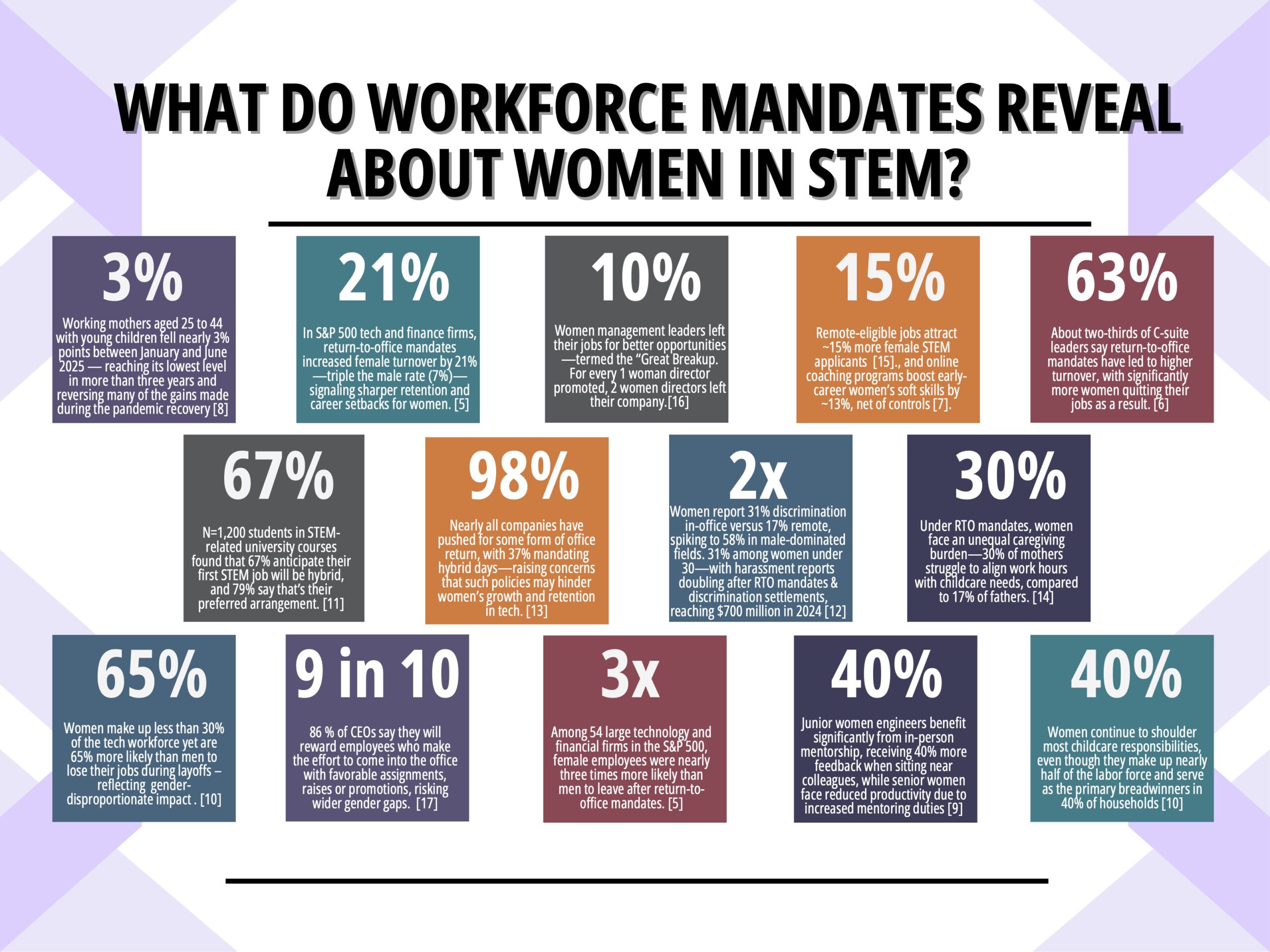
Several insights stem from our findings:
Overall, this underscores an urgent need for more rigorous, data-driven research to better understand the evolving and complex magnitude stemming from RTO mandates. Our findings align with this theme, but we believe that future research should look less at the loss of flexibility under RTO mandates and more about what is gained when flexibility exists — and what and who is at risk when it disappears.
For the SWE research team’s insights on the global perspective on RTO, read The Flexibility Divide: How Global Return-to-Office Mandates Threaten Women’s Progress in STEM.
[1] Shah, A., Lopez, I., Surnar, B., Sarkar, S., Duthely, L. M., Pillai, A., … & Dhar, S. (2021). Turning the tide for academic women in STEM: a postpandemic vision for supporting female scientists. ACS nano, 15(12), 18647-18652.
[2] Elhussein, G., & Hakspiel, J. (2024). Empowering women in STEM: How we break barriers from classroom to C-suite. World Economic Forum.
[3] Mehrotra, P. R., & Das, T. (2025). Work-From-Home Revolution: Enhancing Women’s Participation in STEM. IIM Bangalore Research Paper, (726).
[4] Hsu, D. H., & Tambe, P. B. (2025). Remote work and job applicant diversity: Evidence from technology startups. Management Science, 71(1), 595-614.
[5] Ding, Y., Jin, Z., Ma, M. (Shuai), Xing, B. (Bin), & Yang, Y. (John). (2025). Return-to-Office mandates and the hidden cost of brain drain. Hankamer School of Business, Baylor University.
6] Tsipursky, G. (2024). Are office policies sabotaging gender equality?
[7] Melin, J. L., & Correll, S. J. (2022). Preventing soft skill decay among early-career women in STEM during COVID-19: Evidence from a longitudinal intervention. Proceedings of the National Academy of Sciences, 119(32), e2123105119.
[8] Bhattarai, A. (2025). Mothers are leaving the workforce, erasing pandemic gains. The Washington Post.
[9] Pallais, A. (2024). How remote work impacts women at different stages of their careers. Harvard Kennedy School, M-RCBG GrowthPolicy.
[10] Women Tech Council. (2023). The greatest threat to women in tech: Impact report.
[11] STEM Women. (2024). What do female STEM graduates want? Remote, hybrid or ‘return to office’ [Blog post].
[12] Doe, J. (2025). Return to office: Sex discrimination. The Hill.
[13] Queck, M. (2024). Are return to the office demands killing the growth of women in tech? VIQU IT.
[14] WomenTech Network. (2024). What do return-to-office policies mean for women in the workforce? LinkedIn.
[15] Hsu, D. H., & Tambe, P. B. (2025). Remote work and job applicant diversity: Evidence from technology startups. Management Science, 71(1), 595-614.
[16] Elsesser, K. (2022). A ‘Great Breakup’—female leaders switching employers in unprecedented numbers. Forbes.
[17] Bomey, N. (2024). CEOs reward employees who come to the office, survey shows. Axios.
Rebeca Petean, Ph.D. (she/her), is a research manager for the Society of Women Engineers. Based in Portland, Oregon, her research examines factors influencing women’s persistence in STEM.
All Together is the blog of the Society of Women Engineers. Find stories about SWE members, engineering, technology, and other STEM related topics. It’s up-to-date information and news about the Society and how our members are making a difference everyday.
© 2024 Society of Women Engineers







No Comments