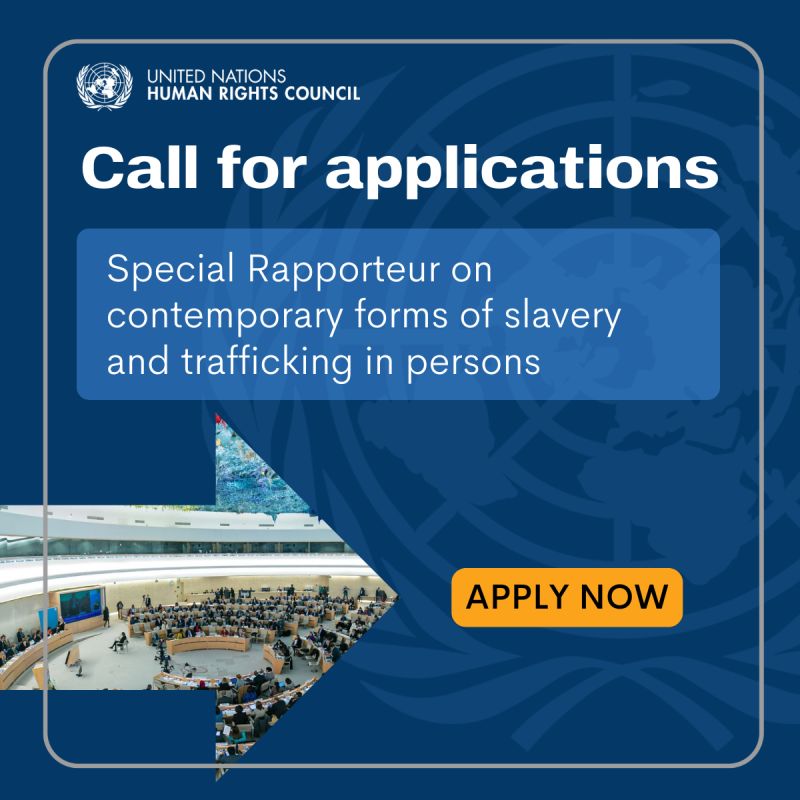
The United Nations Human Rights Council (UNHRC) has launched a call for applications for the newly established mandate of Special Rapporteur on Contemporary Forms of Slavery and Trafficking in Persons, created under Human Rights Council Resolution 60/25. The appointment will be made during the Council’s 61st session, scheduled to take place from 23 February to 2 April 2026 in Geneva, Switzerland.
Qualified individuals with a strong background in human rights, international law, and anti-slavery or anti-trafficking efforts are encouraged to apply. The deadline for submissions is 8 December 2025, at 12 noon Geneva time.
About the Mandate
The new mandate was established during the 60th session of the Human Rights Council to strengthen global accountability and advocacy against modern slavery and human trafficking. The Special Rapporteur will work independently to monitor, report, and advise on issues related to contemporary forms of slavery, including forced labor, debt bondage, child slavery, servitude, and human trafficking.
This role combines the responsibilities of the former Special Rapporteur on contemporary forms of slavery, including its causes and consequences, with an expanded scope that explicitly addresses trafficking in persons. The position underscores the Council’s renewed commitment to combating the evolving forms of human exploitation in a globalized and digitalized world.
Responsibilities of the Special Rapporteur
The appointed expert will:
-
Conduct country visits to assess national and regional progress in addressing slavery and trafficking.
-
Present annual reports to the Human Rights Council and the UN General Assembly.
-
Engage with governments, civil society, survivors, and international organizations to promote best practices.
-
Provide technical assistance and policy recommendations to strengthen prevention, protection, and prosecution mechanisms.
-
Raise global awareness of systemic causes of modern slavery, including inequality, migration vulnerabilities, and economic exploitation.
This mandate is designed to bridge the gaps between advocacy, research, and actionable policy, ensuring a human rights-based approach to ending all forms of modern slavery and trafficking.
Eligibility and Application Requirements
Applicants must demonstrate:
-
Proven expertise in human rights, international law, migration, gender equality, or labor rights.
-
Professional experience related to slavery, human trafficking, or exploitation prevention.
-
Strong ethical standards, independence, and impartiality.
-
Excellent communication and analytical skills.
-
Commitment to upholding the United Nations’ values of equality, non-discrimination, and justice.
The appointment is independent and unpaid, though the United Nations provides administrative and logistical support. Candidates serve in their personal capacity and must act without influence from governments or organizations.
How to Apply
To be considered for the role of Special Rapporteur on Contemporary Forms of Slavery and Trafficking in Persons, applicants must:
-
Complete the online survey
-
Submit the official application form (in Word format), available under the specific mandate section on the UNHRC website.
Applications must be submitted before 8 December 2025 (12 noon Geneva time).
It is important to note that previous applications submitted for the mandate of Special Rapporteur on contemporary forms of slavery, including its causes and consequences will not be automatically considered. Interested candidates must reapply under the new call using the updated survey and application form.
For further details, applicants may consult the Secretariat note verbale of 27 October 2025, which provides full information on eligibility, mandate scope, and procedural guidance.
The Selection Process
The UNHRC’s appointment process for mandate holders follows a transparent and merit-based structure:
-
Application Review – The UN Secretariat collects and screens all submissions.
-
Consultative Group Review – A panel of five independent experts, representing each UN regional group, shortlists and interviews candidates.
-
Presidential Proposal – The President of the Human Rights Council reviews recommendations and proposes final candidates to the Council.
-
Official Appointment – The Council approves appointments during its session, confirming the selected expert’s mandate.
The new Special Rapporteur will begin duties following formal approval at the 61st session.
For more information, visit here.
Why This Mandate Matters
Modern slavery and trafficking affect tens of millions of people worldwide, cutting across borders, industries, and demographics. With new challenges emerging from conflict, displacement, and digital exploitation, this mandate reinforces global efforts to eliminate one of the gravest human rights violations of our time.
By establishing this new position, the Human Rights Council aims to strengthen collaboration among governments, international organizations, and civil society while amplifying the voices of survivors and promoting systemic change.
Stay HERE for more opportunities.










Comments are off for this post.