



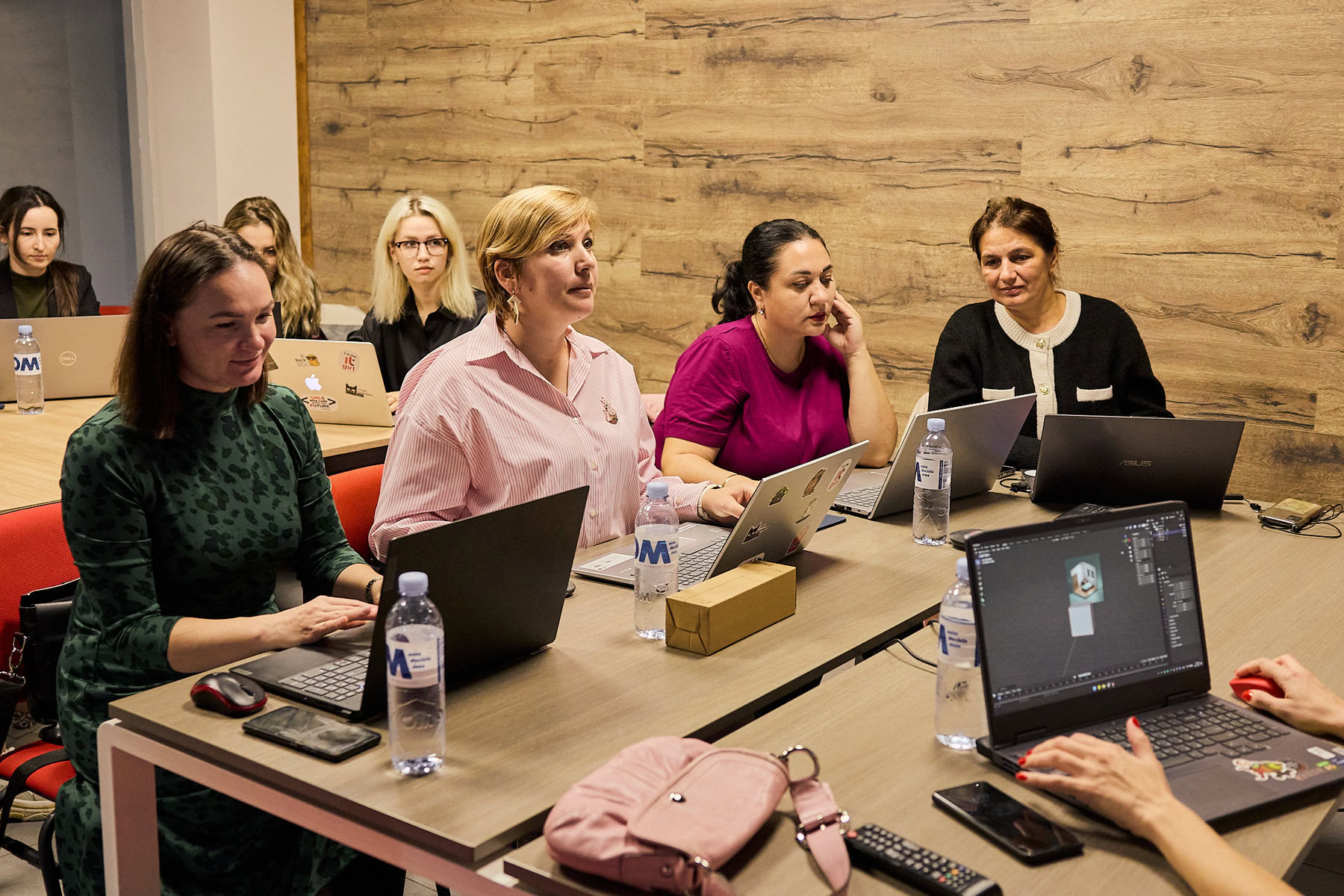

In Moldova, where word spreads quickly, it seems everyone has gotten the memo: Here, women are welcome in tech.
Dina Ceri studied psychology at university. She never considered a technology- or science-based career as she felt she wasn’t good at subjects like math and chemistry. After graduating in 2010, Ceri pursued a career in the education sector. She was initially successful, but soon grew disillusioned.
“I hit a ceiling. The further you get in that sector, it seems, the further you are from the people you’re having a meaningful or impactful relationship with, so I wasn’t interested in continuing in that direction,” says Ceri, who is based in Chisinau, Moldova.
Ceri happened to have a friend who was a mentor for Tech Women Moldova, a program set up to support women in joining the information and communication technology (ICT) sector. Ceri’s friend convinced her she’d be a great fit and would get a lot out of it, so she applied for and completed its three-month project management mentorship program in 2021.
She and two other women were partnered with a project manager at Orange Moldova, one of the country’s biggest telecommunication companies. They learned in-depth about the workings of the industry, from basic technical terminology to what software development and DevOps teams do and how they interact with each other. As a result, Ceri was then able to secure an internship, then a full-time role, at IT company Endava. So began a new, exciting chapter of her career.
Since entering the industry, Ceri has found that the work is surprisingly flexible. “My roles have become more and more technical. And I think that’s the beauty of it, in that you’re not stuck in that one lane that you have chosen. There are so many opportunities, so you can switch directions along the way,” says Ceri.
“What I love is how tangible things are, and how you can implement something immediately. I feel like I’ve opened the door to a whole other universe of opportunities. Whereas when I reached that ceiling in my previous career, all the roles felt similar to each other and there wasn’t anything different that I could try.”
Ceri’s experience perfectly illustrates what is drawing so many women in Moldova to consider careers in the tech industry. Women make up 43 percent of the country’s ICT sector, according to figures supplied by the Moldovan government. Meanwhile, the proportion of female university graduates in ICT fields has steadily risen to 26 percent in 2023, from 22 percent in 2017.
The fact that women make up nearly half of workers in the ICT sector in Moldova is put into perspective particularly when compared with other — bigger and more economically successful — countries. In the US, women make up 28 percent of the tech industry, and in the UK, it’s just 19 percent. Women make up 22 percent of the wider European tech sector. In Asia, it’s around 32 percent, indexing higher in Singapore at around 40 percent. In Australia it’s around 29 percent, while in Latin America, it ranges from 17 percent to 22 percent. With a population of just 2.5 million, and GDP of $14.5 billion (compared with, say, the $37 billion profit of Amazon), it’s fair to say this is an area where Moldova is punching well above its weight.
So how has this under-the-radar Eastern European country created an environment where women are attracted to, and thriving in, this industry?
The answer stems largely from a push by the United Nations Development Program (UNDP), which has identified advancing the country’s digital infrastructure as a way of creating more opportunities and economic prosperity in a country which, despite significant growth over the past 20 years, remains one of the poorest in Europe. The UNDP has helped Moldova develop a National Strategy for Digital Transformation, a big part of which is getting more women into STEEAM (science, technology, engineering, entrepreneurship, art and math) careers.
Globally, between 40 million and 160 million women will need to change occupations by 2030 into more skilled roles requiring complex digital, cognitive, social and emotional skills, according to the UNDP. As STEEAM-based roles are expected to be in high demand, the UNDP surmises, helping women get into, and succeed, in these fields — by working closely with academia, schools, civil society organizations and the media — will be crucial.
As a result, the UN has a big presence in the Moldovan tech sector. It supports programs like Tech Women Moldova, which has accepted 371 mentees since 2021, and an online learning platform set up by the Moldovan Association of ICT Companies, which has seen 1,000 women sign up. It’s also involved in Girls Go IT, which has had 3,000 participants from all over the country in its educational programs. From women-focused STEEAM university summer schools to women in tech conferences and school programs, the individual initiatives are too numerous to mention, but it’s clear Moldova has a passionate ecosystem of women intent on lifting other women up into an industry that hasn’t always been known around the world to be female friendly, or gender equal.
A gender-balanced tech industry is fast becoming the norm in Moldova, as the movement is changing the mindsets and decisions not only of women like Ceri, but of companies and schools, too. In a small country where word spreads quickly, it seems everyone has gotten the memo: Women are welcome in tech, as Marina Bzovii observes.
She’s an administrator at Moldova IT Park, a hub set up by the government to make it easier for tech businesses to launch and operate in the country, through the country’s low tax system and its special IT visa for attracting foreign workers. She’s also an assistant professor at the Technical University of Moldova and has worked as a technical program manager, despite originally studying law.
“When you showcase women in the tech industry in a small country, the message reaches a lot of women. Our big [telecommunications] companies have women in leading roles, and they are used a lot as role models. Lots of companies now informally have policies to have gender-balanced leadership, and working with the university, more companies are now offering internships that are reaching more women, too,” says Bzovii.
Join the Reasons to be Cheerful community by supporting our nonprofit publication and giving what you can.
“It’s been a process. We’ve had to change even the mindset of teachers, who, 10 years ago, actually believed that women shouldn’t be in the tech sector. Now there’s no such stereotype, and we even see the mindset of parents has changed. It’s growing day by day.”
A culture of women paying it forward is also strong in Moldova. Ecaterina Artemiev started as an ambassador and coordinator for Tech Women Moldova in 2023. This year, she took on the role of mentor, supporting four mentees in the quality assurance field, something she has specialized in with her role at IT consultancy Stefanini.
“We work towards the mentees’ goals. Let’s say she wants to increase her salary. We create a plan for that — what courses she should study, reviewing her resume, how to achieve certain certifications, especially ones that mentors already have,” says Artemiev.
“They just need to be supported and motivated. When I started in this industry, I didn’t have a mentor, and I know what difference it makes if you have at least one person you can go to for advice. That’s why I thought it’s time to share my knowledge.”
It’s a vibe Dina Ceri is here for. “There are a lot of strong women that support each other and try to open the door for other women,” she says. “Because it’s such a small country, you can easily come up with a program and promote it, whether it’s a book club or a conference. It’s a tighter community in general, here.”
In the US, Girls Who Code aims to close the gender gap in new entry-level tech jobs by 2030.
MaryLou Costa is a freelance writer fascinated by the future of work, especially changes that advance women in the workplace. She also covers sustainability, innovation, technology, startups, marketing and more. Her work has featured in The Guardian, The Observer, Business Insider, Raconteur, Sifted, Digiday, Marketing Week and others, plus she has appeared on Times Radio, BBC and Sky News.
Only 2% of electricians are women, leaving plenty of room for growth in a field that is finding creative new ways to recruit them.
Covid put a multi-year gap in millions of resumés. Now some companies are offering a supportive path back.
To change the misperception that scientists are all old white guys in lab coats, thousands of women scientists are banding together to make their voices heard.
Our smart, bright, weekly newsletter is the uplift you’ve been looking for.
Listed below are all the stories you’ve bookmarked. If you clear your cookies or switch to another browser or device, this list may disappear.
We don’t use any cookies that spy on you, sell your information or spam you. Read our privacy policy here. More info and adjust your cookies settings here Cookie settings
We need to raise $75,000 by the end of the year. Will you help us get there?
No, thank you