The world stands at a pivotal juncture. Our current economic model, driven by fossil fuels, linear production and consumption patterns, and a relentless pursuit of growth at any cost, is accelerating climate change, biodiversity loss, pollution, and deepening inequalities. Yet across the globe, momentum is building behind a transformative vision: economies reshaped around sustainability, equity, and human well-being.
The transition to an inclusive green economy offers more than environmental protection. It represents an opportunity to address historical injustices, create decent jobs, and build societies capable of thriving amid the challenges of the 21st century.
About the Course
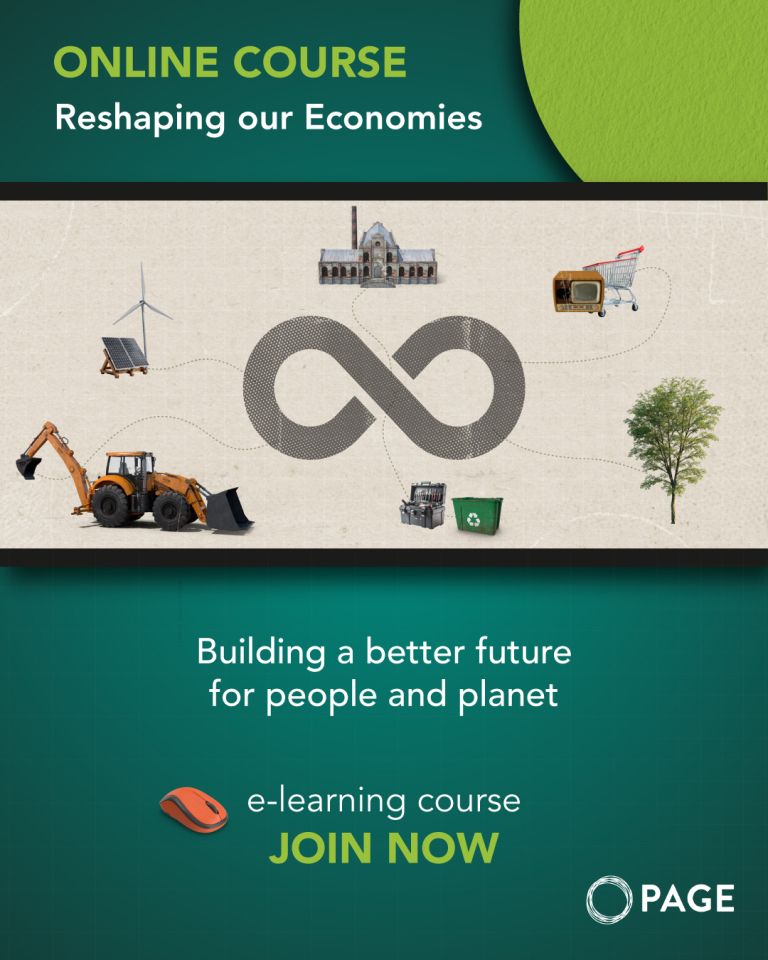
Reshaping Our Economies is a comprehensive self-paced e-learning course that explores how countries and institutions can drive the shift toward inclusive green economies. Through engaging videos, interactive lessons, real-world case studies, and practical exercises, participants gain the knowledge and tools necessary to support fair, job-rich, and sustainable economic transformations.
The course situates learners within this global shift, offering practical insights into how upstream economic policies, fair transition strategies, and sustainable finance can drive transformative change. Drawing on real-world examples from the Partnership for Action on Green Economy’s 22 partner countries, the course demonstrates how governments, financial institutions, civil society organizations, and businesses can align economic, social, and environmental goals in practice.
Course Duration: 4.5 hours
Format: Self-paced
Language: English
Certification: Free certificate of completion available
What You Will Learn
The overarching goal of this course is to demonstrate how changes in upstream policy-making, including trade, fiscal, industrial, and employment policies, have the potential to shift entire economies toward green and inclusive transformation.
Upon completing the course, learners will be able to explain why upstream economic policies serve as key levers for achieving sustainable development goals. Participants will learn to identify enabling conditions and specific policy entry points for advancing green, circular, and job-rich economies. The course outlines tools and policies that can help unlock and redirect both public and private finance toward sustainable outcomes.
A critical component addresses the social impacts of green economic transformation, examining approaches for mitigating negative effects on vulnerable groups and ensuring that no one is left behind. Throughout the course, learners encounter concrete examples from different countries showing how the transition unfolds in practice, providing inspiration and practical guidance for their own contexts.
Course Structure
The learning experience is organized into three distinct modules, each with specific learning objectives and featuring a mix of short introductory videos, interactive lessons, case studies, and exercises.
Module 1: Economies in Transition
This foundational module explores the fundamental shifts required to move from our current economic model to one centered on sustainability and inclusivity. Participants examine the drivers of change and the systemic transformations necessary for achieving green economy goals.
Module 2: Making the Transition Just
The second module focuses on equity and fairness throughout the transition process. It addresses how to ensure that the shift to a green economy creates opportunities rather than hardship, particularly for vulnerable populations and communities dependent on traditional industries.
Module 3: Financing the Transition
The final module examines the financial mechanisms and policy tools necessary to fund green economy transitions. Participants explore how to mobilize and redirect capital, both public and private, toward sustainable development objectives.
Who Should Take This Course
This course will be valuable for diverse audiences committed to sustainable economic transformation.
Public sector officials involved in national economic, trade, fiscal, industrial, and employment policy will find practical guidance for integrating green economy principles into their work. Staff from line ministries and sub-national governments can gain insights into cross-sectoral approaches to sustainability.
Professionals working for financial institutions, including private banks and insurance companies, will learn how their organizations can support and benefit from the transition to green economies.
Representatives from employers and workers associations, civil society groups, universities, and think tanks interested in inclusive green economy transitions will discover frameworks and tools for advancing their advocacy and research.
The course also serves as a trustworthy learning resource for ministries, development partners, private companies, or other entities seeking quality training materials for internal staff development.
About the Partnership for Action on Green Economy
The course has been developed with support from PAGE, a joint initiative of UNEP, ILO, UNDP, UNIDO, and UNITAR. Since 2013, PAGE has worked with partner governments and institutions to reframe economic policies and practices around sustainability, promoting growth, job creation, poverty reduction, inequality reduction, and ecological resilience.
Each partner organization brings specialized expertise to the initiative. UNEP hosts the PAGE Secretariat and coordinates research on green economy indicators, measurement frameworks, and trade. The ILO contributes knowledge on employment, green jobs, gender equality, and skills development. UNDP provides expertise in integrated policy design, poverty eradication, and engagement with government, private sector, and civil society partners.
UNIDO delivers specialized knowledge on developing and greening industrial sectors, helping countries sustainably diversify their economic drivers. UNITAR develops institutional and societal expertise to sustain and implement green economy policies through training programs and policy dialogues.
Certification Requirements
Participants who successfully complete the course requirements will receive a certificate of completion. To earn certification, learners must complete all videos, interactive lessons, and learning activities, and pass the final quiz with a minimum score of 70 percent within three attempts.
Once these requirements are met, the certificate becomes available for automatic download. Please note that a small fee now applies to downloading certificates of completion for some courses, though all course content remains completely free. This change helps keep climate change learning accessible to all while supporting the continuation of these crucial educational resources.
Supporting Climate Change Literacy
This course forms part of a broader mission to equip people worldwide with the skills and knowledge needed to make informed decisions, take effective action, and address the climate crisis. By making high-quality learning resources accessible to diverse audiences, the program supports the development of the expertise necessary for navigating and accelerating the transition to sustainable economies.
The knowledge gained through this course empowers participants to become agents of change within their organizations and communities, contributing to the collective effort to reshape our economies for a sustainable and equitable future.
Enroll Today
Ready to explore how economic transformation can drive sustainability, equity, and well-being? Access the full course syllabus and enroll in Reshaping Our Economies today. Join learners from around the world in gaining the insights and tools needed to support the transition to inclusive green economies.
For more information and to begin your learning journey, visit the course page and start building the expertise needed for tomorrow’s sustainable economy.
For more information, please visit their website here.
Stay on opportunitiesforwomen.org/ for more opportunities






Comments are off for this post.