The Center for International Development (CID) is Harvard University’s hub for cutting-edge research on the world’s most pressing international development issues. Based at Harvard Kennedy School, CID brings researchers and practitioners together across the university to collaborate, using the latest analytical tools to address pressing development challenges. CID builds, convenes, and deploys global talent worldwide to build a thriving world for all.
About GEAR:UP Initiative
Housed within the Center for International Development, the Global Education and Research: Unleashing Potential (GEAR:UP) initiative is focused on transforming education systems to improve learning outcomes. Despite increases in school enrollment, global learning levels remain stagnant, with millions of students lacking basic literacy and numeracy skills. Expansions in enrollment have created more diverse classrooms, yet educational outcomes and per-student spending have not improved at the same rate.
Through its work, GEAR:UP aims to create personalized learning journeys at scale using big data and AI to improve education quality. The research uses a systems approach, which addresses interconnected challenges and fosters collaboration among diverse stakeholders. Ultimately, the goal is to get on track to 2030 with Sustainable Development Goal (SDG) 4: ensuring inclusive, equitable, and quality education for all.
Position Overview
CID research fellows work closely with faculty on specific research projects. This fellowship, under the direction of Professor Asim Khwaja, will focus primarily on education research but may also include projects on labor, governance, or taxation depending on staffing needs.
Professor Khwaja’s Research
Professor Khwaja’s work uses system-level randomized control trials to assess the impact of educational interventions. His work is distinguished by its integration of extensive fieldwork, rigorous empirical analysis, and microeconomic theory to address policy-relevant issues using a systems approach.
His most recent projects include:
- A technology-enabled Targeted Instruction intervention in public primary schools in Islamabad
- A study supporting parents in increasing accountability and service delivery quality in public schools in Punjab
- A series of papers on education financing in both public and private schools
This fellowship will focus primarily on research in Pakistan, Saudi Arabia, and potentially Colombia, providing a unique opportunity to engage in cutting-edge research on pressing educational and economic challenges in these regions.
About Research Fellows
Fellows come from diverse backgrounds and bring highly valued technical skillsets and cultural perspectives to research teams. Fellows receive mentoring from faculty, work with cutting-edge topics and research methods, and participate in a broad range of activities at the Harvard Kennedy School. They are welcomed as members of the Harvard community and receive salary, benefits, and access to an array of University resources.
Fellows are among the best and the brightest of future researchers and practitioners in Economics, Public Policy, and related fields, and many go on to graduate study or pursue careers outside of academia, supporting and implementing evidence-based policy from a wide variety of organizations.
Key Responsibilities
- Clean and manage large datasets
- Conduct statistical analyses in Stata
- Develop survey instruments and data request documents for data collection
- Create technical documentation for internal and external audiences
- Prepare literature reviews, background research, and other draft content for academic papers
- Draft content for reports to policymakers, academic papers, grant proposals, research protocols, and other project documents
- Coordinate with a variety of research team members at CID and partner organizations, including those based internationally
- Travel to the field as needed
Required Qualifications
Educational Background
- Bachelor’s or Master’s degree in Economics, Public Policy, International Development, or related field requiring substantial coursework in math and economics
- Demonstrated academic excellence
Technical Skills
- Proficiency in Stata, working with large, complex datasets
- Coursework in empirical methods, including econometrics and economics, and knowledge of randomized control trials
- Excellent command of Microsoft Office suite (Microsoft Word, Excel, and PowerPoint)
Research Interests and Communication
- Strong interest in education, public policy and economic development in low-income countries
- Excellent English oral and written communication skills
Personal Qualities
- Strong motivation, self-direction, and organizational skills
- Enthusiasm for collaborating with a diverse team, including international colleagues
- Willingness to travel internationally
Preferred Qualifications
- Master’s degree in Economics, Public Policy, International Development, or related field requiring substantial quantitative coursework
- Experience with survey design and implementation using Qualtrics or SurveyCTO
- Strong ability to integrate research and policy into coherent and effective written materials
- Well organized, able to prioritize, have a strong attention to detail and manage multiple assignments simultaneously
- Strong interpersonal skills and the ability to interact well with faculty, staff, students, and research partners in developing countries
- Previous experience as a research assistant in the fields of Public Policy or Economic Development
Application Requirements
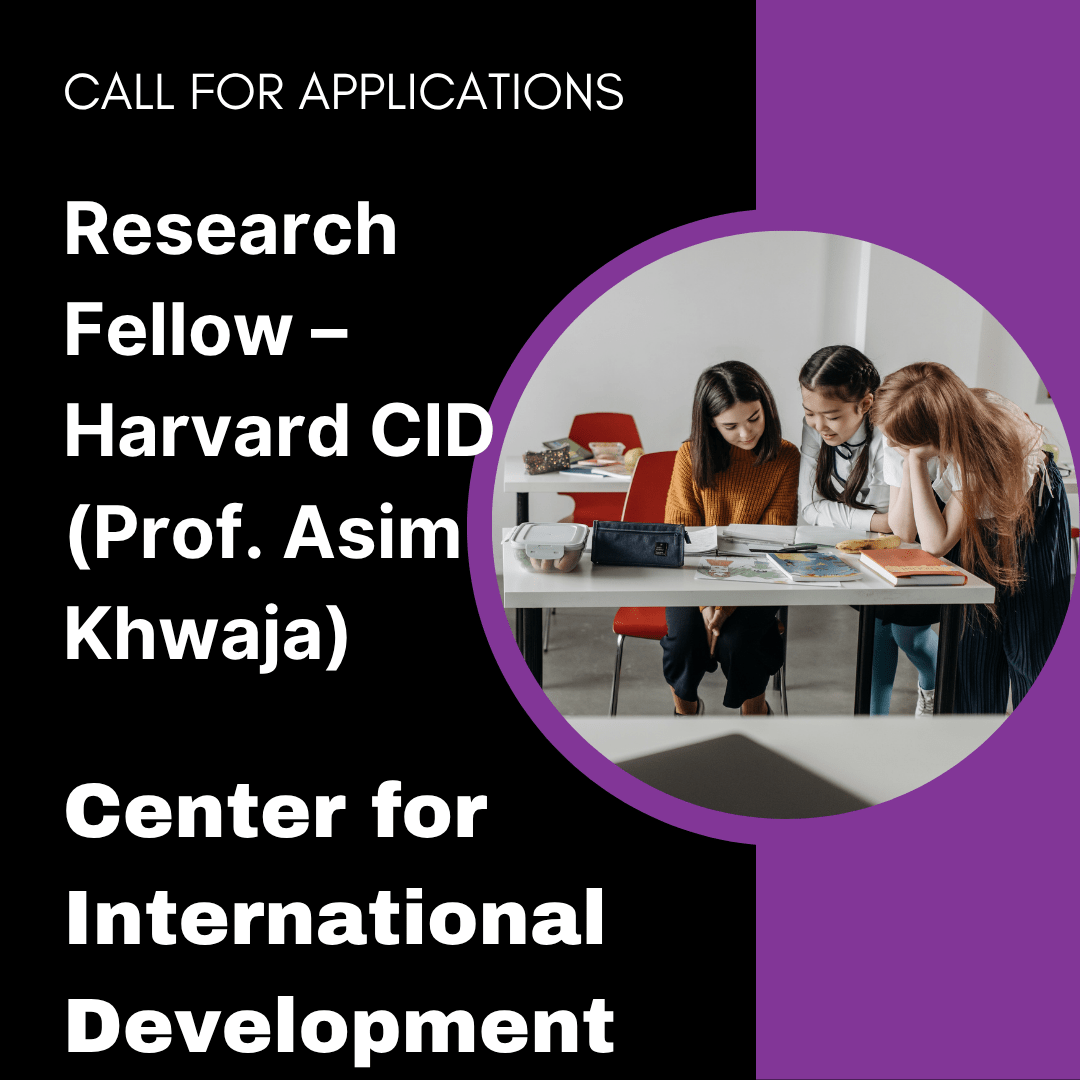
Applications must be submitted through the J-PAL/IPA common application. After completing a brief registration, choose the University-based Data Research Associate position type “Research Fellow – Harvard CID (Prof. Asim Khwaja)” and include the following materials:
Required Documents
Cover Letter: One page maximum
Curriculum Vitae
Coding Sample: Demonstrating data analysis skills in Stata (preferred), R, or Python. To ensure a blind, bias-free grading process, candidates must redact their name or other information that could be used to identify them as a candidate (including versions of their name in referenced file paths) from anywhere it appears in the file. Applications with personal identifiers in the coding sample will be considered incomplete.
Two Letters of Recommendation: From academic (preferred) or professional references. Applicants are able to submit their application before references complete their recommendation letters; however, contact information must be included before submitting the application.
Transcripts: From all degrees completed and in-progress. Unofficial copies are acceptable.
Important Notes
Candidates may also be considered for similar positions at collaborating institutions. Applicants should opt-in to open recruitment when completing the J-PAL/IPA common application.
Applications are reviewed on a rolling basis and will not be considered complete until all elements (excluding letters of recommendation) are received.
Selection Process
Given the volume of applications received, only short-listed candidates will be contacted. Applicants chosen to move forward in the hiring process will be required to:
- Take a Stata exam
- Participate in multiple interviews
- Provide additional materials as requested
Benefits
Fellows receive:
- Competitive salary
- Benefits package
- Access to Harvard University resources
- Mentoring from faculty
- Participation in Harvard Kennedy School activities
- Membership in the Harvard community
- Professional development opportunities
For questions about the position or application process, please contact:
cidfellowapplications@hks.harvard.edu
For more information about CID, visit: https://www.hks.harvard.edu/centers/cid
For more information about GEAR:UP, visit the GEAR:UP webpage on the CID website.
Stay on opportunitiesforwomen.org/ for more opportunities






Comments are off for this post.