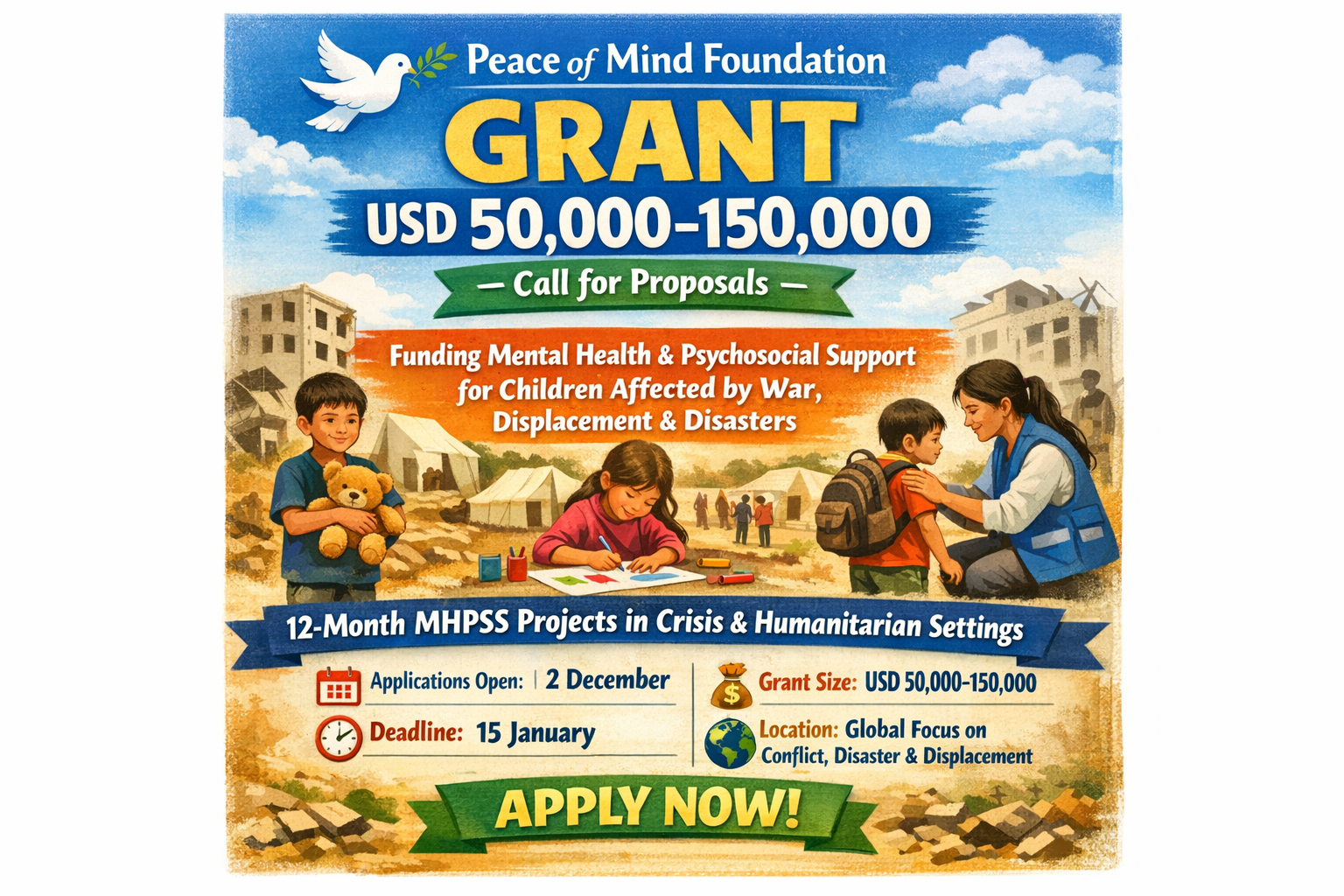
The Peace of Mind Foundation is inviting eligible organisations to apply for its latest Call for Proposals supporting Mental Health and Psychosocial Support (MHPSS) projects for children affected by war, displacement, violence, and natural disasters.
Every day, millions of children face severe trauma in crisis settings. Exposure to conflict, disaster, and prolonged instability leaves many struggling with psychological distress, loss, and disrupted development. The Peace of Mind Foundation funds life-changing, evidence-based MHPSS interventions that restore hope, resilience, and wellbeing for children living in these contexts.
Call for Proposals Timeline
-
Applications open: 2 December
-
Applications close: 15 January
Only organisations that successfully complete the Eligibility Check will be invited to submit a full proposal.
What the Peace of Mind Foundation Funds
The Foundation supports projects that:
-
Focus primarily on Mental Health and Psychosocial Support (MHPSS)
-
Target children and adolescents affected by:
-
Armed conflict and war
-
Forced displacement and migration
-
Violence and insecurity
-
Natural disasters
-
-
Are led by organisations with demonstrated technical capacity and experience in MHPSS
-
Operate in humanitarian or fragile contexts worldwide
Community-based, clinical, and integrated MHPSS approaches are all eligible, provided the mental health and wellbeing of children remain central.
Grant Size and Duration
-
Typical grant size: USD 50,000–150,000 per year
-
Recommended project duration: 12 months
-
Funding disbursement begins: March–April 2026
Consortium applications and projects with co-funding are welcome.
How to Apply for a Peace of Mind Foundation Grant
Step 1: Complete the Eligibility Check
All applicants must complete a short online Eligibility Check. Only organisations that meet all criteria will be automatically redirected to the full application form.
Eligibility questions assess:
-
Whether the project focuses on MHPSS
-
Whether children or adolescents are a primary target group
-
Whether the organisation works in crisis-affected contexts
-
Organisational experience in MHPSS
-
Operational and community engagement capacity
Step 2: Submit a Full Proposal
Eligible organisations must complete the online application form via the Foundation’s website. Applicants are strongly encouraged to review the Proposal Guideline and Frequently Asked Questions (FAQs) before submission.
Email submissions are not accepted.
Step 3: Review and Shortlisting
Following the deadline:
-
All proposals will be reviewed
-
Shortlisted organisations will be invited to a technical interview
-
Application status updates will be shared via LinkedIn, not by email
Project Proposal Guidelines
Proposals must clearly and concisely address the following sections.
1. Project Overview
Include:
-
Project title
-
Location (country, region, or city)
-
Start and end dates
-
Total budget requested (USD, EUR, CHF, or GBP)
2. Organisational Capacity
Describe:
-
Organisational structure and staffing
-
Permanent and project-specific personnel
-
Office locations and operational infrastructure
-
Technical expertise in MHPSS
-
Relevant past and ongoing MHPSS projects
-
Any additional staffing or infrastructure required
3. Problem Statement
Present a compelling, evidence-based justification for the project, including:
-
Contextual background
-
Target population
-
Mental health and psychosocial challenges faced
-
Data or credible qualitative evidence demonstrating urgency
4. Project Design and Objectives
Clearly outline:
-
Overall objective(s)
-
Theory of Change
-
Intended outcomes
-
Expected outputs
-
Methodology and activities
-
Anticipated impact at individual and community levels
Both qualitative and quantitative indicators are encouraged.
5. Community Engagement and Participation
Explain:
-
How communities will be consulted and involved
-
Community roles in design and implementation
-
Feedback and accountability mechanisms
-
In-kind or logistical contributions
-
Strategies to foster ownership and sustainability
6. Alignment with National Policies
Describe how the project aligns with relevant national mental health strategies or action plans, where applicable.
7. Target Beneficiaries
Specify:
-
Number and profile of beneficiaries
-
Inclusion of vulnerable or marginalised groups
-
Accessibility and equity considerations
8. Monitoring and Evaluation (M&E)
Detail:
-
Monitoring framework and tools
-
Indicators and data collection methods
-
Learning and adaptive management processes
-
Use of evidence to improve implementation
9. Sustainability
Explain how project outcomes will be sustained beyond the grant period through:
-
Capacity building
-
Integration into local systems
-
Community leadership and ownership
10. Risk Management
Identify:
-
Key risks (contextual, operational, logistical)
-
Mitigation and contingency strategies
-
Adaptive management approaches
11. Child Safeguarding Policy
Describe:
-
Safeguarding principles and procedures
-
Risk identification and reporting mechanisms
-
Staff and partner training
-
Child-friendly complaint and feedback systems
12. Budget and Financial Management
Provide:
-
Clear budget administration processes
-
Financial oversight mechanisms
-
Roles and responsibilities for fund management
-
Safeguards against misuse
13. Detailed Budget
Submit an itemised budget including:
-
Personnel costs
-
Programme activities
-
Materials and equipment
-
Transport and logistics
-
Administration and overheads
Each line item should show unit cost, quantity, and total.
Find out more on what is expected in proposals. Proposal blueprint
Use of AI Tools
If AI tools are used during proposal preparation, applicants must disclose this and confirm that AI support is limited to editing or formatting only. All substantive content must accurately reflect the proposed project design.
Frequently Asked Questions Highlights
-
Proposals must be submitted in English
-
Email submissions are not accepted
-
Multiple proposals may be submitted, but only one grant is likely per organisation
-
Organisations with 5+ years of MHPSS experience are strongly encouraged to apply
Find answers to the most common questions about the Call for Proposals. Frequently Asked Questions
Apply Now
Full application details, eligibility checks, and submission portal are available at:
https://peaceofmind-foundation.org/
For general enquiries:
info@peaceofmind-foundation.org
Help Restore Hope to Children Scarred by War
By funding high-quality MHPSS interventions, the Peace of Mind Foundation supports children in rebuilding emotional wellbeing, resilience, and a sense of safety in the world’s most challenging contexts.
Organisations working on the frontlines of child mental health in emergencies are encouraged to apply.