The Royal Commission for the Exhibition of 1851 (RC1851) has a long-standing mission: to “increase the means of industrial education and extend the influence of science and art upon productive industry”.
One of the premier ways it fulfils that mission today is through its Industrial Fellowships programme: an opportunity for outstanding graduates and their sponsoring companies to engage in impactful research, combine academic rigour with industry relevance, and drive innovation in British industry.
These Fellowships open a unique pathway: enabling a graduate to pursue doctoral-level research in partnership with an industrial sponsor, enjoy substantial funding and resources, and link academic excellence with commercial impact. For companies, it’s a chance to craft a bespoke PhD project aligned with their strategic goals, to access leading academic expertise, and build lasting research partnerships.
In this article we will explore in depth the key features of the Industrial Fellowships, the benefits, eligibility, how to apply, and the wider impact and legacy of the scheme, drawing on the RC1851 website and supporting materials.
Programme Overview
Purpose and Rationale
The Industrial Fellowships programme is guided by the dual goal of promoting innovation in British industry and supporting the career development of high-potential researchers. From the RC1851 website:
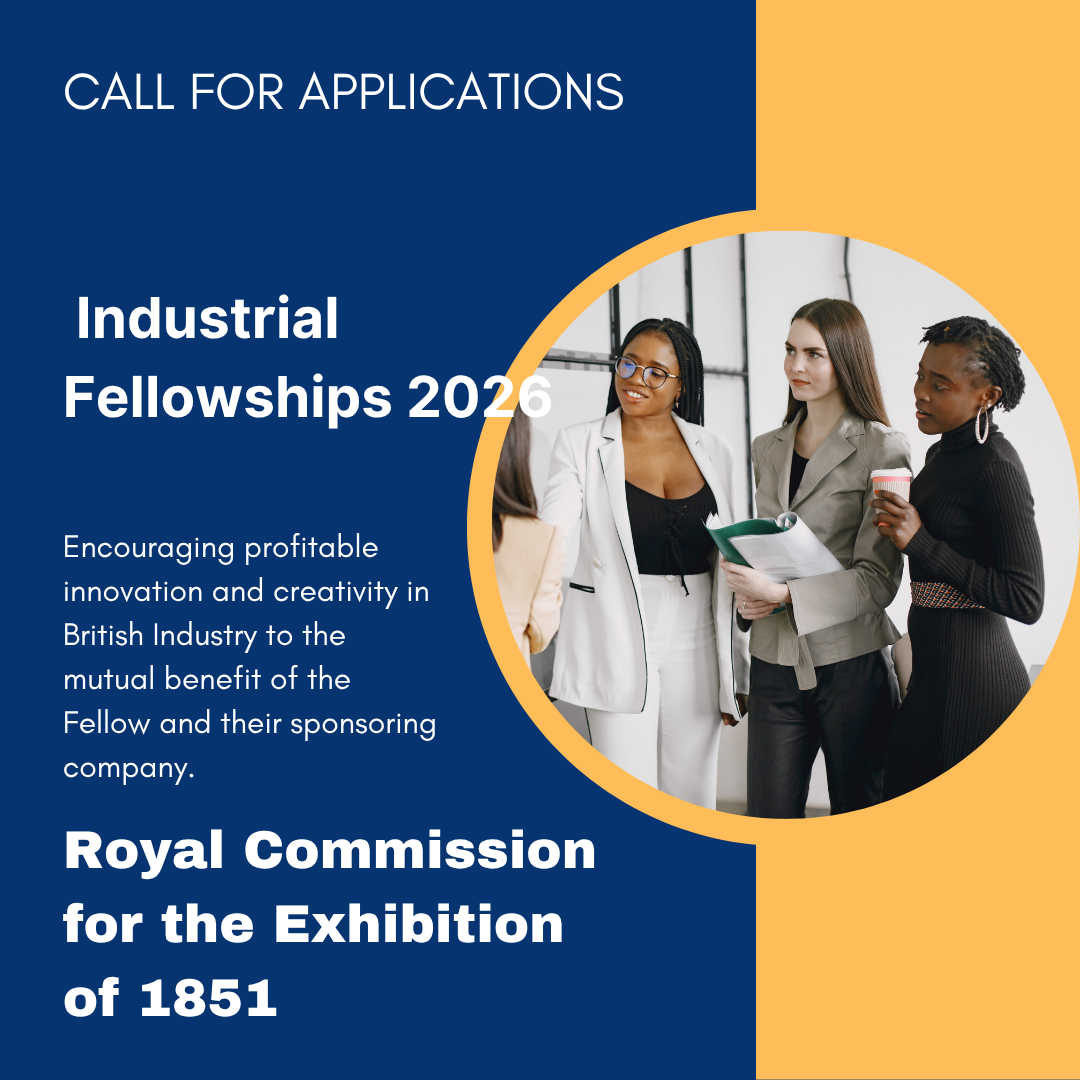
“Encouraging profitable innovation and creativity in British Industry – to the mutual benefit of the Fellow and their sponsoring company.”
In essence, it is designed around these core ideas:
- A graduate researcher who has the potential to make an exceptional contribution to industry.
- A sponsoring company that will support and benefit from the research.
- A research programme that is firmly embedded in an industrial context, linked to outcomes such as a patent, product or process improvement.
- A university or higher education institution that will serve as the academic host, enabling doctoral-level research aligned with industrial goals.
By bridging the world of academia and industry, the scheme aligns with RC1851’s charter to support industrial education and innovation. The programme emphasises not just academic excellence, but tangible impact on industry.
Key Programme Dates (2026 cycle)
According to the RC1851 website for the 2026 cycle:
- Deadline for applications: 10 February 2026 (Midday).
- Interviews: 24 March 2026.
- Fellowship commencement: October 2026.
Applicants are encouraged to get in touch with the Fellowship Programme Manager (Helen Harris) for advice and questions prior to submission.
Apply Here!
Funded Research and Industrial Impact
The Fellowship enables the pursuit of a PhD whilst working (or otherwise engaged) with a sponsoring company, with substantial funding towards fees and salary. The aim is to enable a project that leads to new intellectual property (IP) and to industrial benefit.
Not only does the Fellow gain doctoral credentials, but the sponsoring company builds long-term links with academia, gains access to expertise and resources, and potentially develops valuable innovations. The host academic institution participates and benefits from a connection to industry.
Discipline Scope
Projects in any science or engineering discipline are eligible: the boundary is wide to allow for diverse industrial research. From the website:
“Projects in any science or engineering discipline will be considered.”
This flexibility means that candidates from physics, chemistry, materials science, engineering, computer science, and related domains can apply, as long as the project has industrial relevance.
Eligibility & Benefits
Eligibility
To be eligible for an Industrial Fellowship, the candidate and sponsoring company must meet certain criteria, including:
- The candidate is a graduate with demonstrated potential to make an outstanding contribution to industry.
- The research must be supported by a company (which acts as the sponsor) and intended to lead to a patent, product or process improvement.
- The candidate may either be company-employed or nominated through a sponsored doctoral centre (such as a UK EngD or industrial doctorate programme) by the sponsoring company.
- For company employed candidates: often with first degree in engineering/science/medicine; the company is UK-based.
- In some historic descriptions: within five years of first degree or early in career.
Applicants should carefully check the current “Terms and Conditions” for full eligibility rules (these vary by year). For 2025/26 cycle these can be downloaded (see references).
Key Benefits
The benefits to both the candidate and the sponsoring company are substantial. Key features include:
For the Fellow (candidate):
- The opportunity to pursue a PhD or equivalent doctoral award aligned with industrial goals.
- Significant funding towards salary/fees, enabling the candidate to conduct advanced research whilst linked to industry.
- Access to a network of former Fellows, mentors, and the RC1851 Alumni community.
- Exposure to a high-impact environment combining academic rigour and industrial challenge.
For the sponsoring company:
- The chance to design a bespoke PhD project from the ground up, tailored to the company’s strategic needs and aligned with its capabilities.
- Access to leading academics, advanced facilities and expertise, enabling high-quality research that supports the company’s objectives.
- Potential development of new IP, patents, products or process improvements. The scheme’s framing emphasises “gain new IP whilst minimising R&D costs”.
- Fostering a long-term academic–industry collaboration beyond the duration of the Fellowship.
Additional Funding Details (Historic / Typical)
For example, in earlier rounds, the scheme provided:
- Travel allowance of up to £3,500 per annum for all candidates.
- An honourarium to the host university research department of £10,000 on completion of the project. (Historically.)
- For company-employed candidates: partial salary cover (historically up to £21,000 per annum) plus fees paid.
- The 2025 Terms and Conditions document states that the funding is not intended to cover routine laboratory consumables.
Because funding details may change from year to year, applicants should always consult the current official Terms and Conditions.
How to Apply
Pre-Application Preparation
Given the competitive nature of the fellowship, preparation is key. Prospective applicants (and their sponsoring companies) should consider the following:
- Identify a sponsoring company — A UK-based company willing to support the project and commit resources (supervision, infrastructure, possibly employment of the Fellow).
- Define a research project — A well-conceived project that sits at the interface of industry and academic research, with potential for commercial output (patent, new product or process improvement). The project should be based in a science, engineering or technology discipline and clearly link the company and university.
- Secure academic supervision — A UK university or research institution that will host the Fellow, provide supervision, and necessary infrastructure.
- Demonstrate commitment and collaboration — The application should show a strong link between the company, Fellow, and university; letters of endorsement from the industrial supervisor and academic supervisor will strengthen the case.
- Check timelines and programme documentation — Ensure you understand the deadline (10 February 2026 midday for the 2026 round). Understand the Terms and Conditions, funding model, deliverables, & expectations.
- Contact the Fellowship Programme Manager — As the RC1851 website suggests: “We encourage those interested in applying to get in touch with our team, who can answer questions and offer advice about the process.”
Apply Here!
Application Components
The typical application will include (based on guidance from host universities):
- A detailed research proposal: including aims, methods, milestones, deliverables, industrial impact, and how the project will benefit the company and the field.
- Curriculum Vitae of the candidate, showing academic achievements, relevant experience, and demonstration of potential to contribute to the industry.
- Company profile: detailing the sponsoring company, its strategy, how the project aligns with its goals, how it will support the Fellow, and what is expected from the research.
- Institutional (university) host details: including the academic supervisor, resources available, and commitment to the project.
- Endorsement letters: from the industrial supervisor and academic supervisor. These show that all parties are committed and that the project is well-embedded.
- Additional documents as required by the specific Terms & Conditions for that year. For example, the 2025 T&Cs mention that the funding does not cover routine lab consumables.
Selection Process
Based on RC1851’s website and host-university commentary:
- Applications are submitted by the deadline (10 Feb 2026 for the upcoming round).
- Shortlisted candidates are interviewed (24 March 2026). The interview assesses the candidate’s potential, the quality of the project, and the likelihood of industrial impact.
- Outcomes announced, and the Fellowship commences in October 2026.
- The host university (and possibly the industry partner) may have an internal selection process before the RC1851 submission. For example, in one case, the university’s internal EOI deadline was 06 November 2025 for the 2026 round.
Tips for a Strong Application
Drawing from practitioner advice:
- Be specific. The research proposal must clearly articulate the industrial context, the innovation, the deliverables, the commercial relevance, and how the candidate and company will work together. > “I think the fact that I mentioned a specific thing in my statement. I think that’s what made my application stand out.”
- Show a strong industrial link and a realistic path to impact. The reviewers will look for evidence that the project will benefit industry and is not just academic.
- Demonstrate motivation and vision, not just past achievements: articulate your career ambitions, how the Fellowship will help you, and how your work will help the company and industry.
- Secure good endorsements: letters from the industrial supervisor and academic supervisor that show commitment will strengthen the application.
- Understand the funding model and expectations: ensure you address deliverables, milestones, the industrial partner role, academic partner role.
- Familiarize yourself with the values of RC1851: alignment with innovation, industrial relevance, science & engineering excellence, and collaborative research. > “Innovation, the willingness to lead a sector within British industry, and a personal vision for your career.”
Apply Here!
The Legacy and Impact of the Scheme
Historical Background
The Royal Commission for the Exhibition of 1851 was originally established to administer the Great Exhibition of the Works of Industry of All Nations (1851) and then used its proceeds to found a trust whose charter is to extend science, art, and industrial education.
Over time, the Commission shifted from exhibition-making into awarding postgraduate scholarships, fellowships, and supporting industrial education. It has been awarded many prestigious awards—alumni include Nobel Laureates and industry leaders.
Alumni Network & Prestige
The RC1851 alumni network is strong: the website notes that since 1891, the Commission has been awarding fellowships and scholarships, and “previous holders of these prestigious awards include 13 Nobel Laureates” (as of the site’s writing).
Being selected as a Fellow thus not only provides financial support and research opportunity, but also social capital, access to networks, and an enduring affiliation with a historic and highly regarded institution.
Industrial and Societal Benefits
By design, the Industrial Fellows scheme fosters research with direct industrial relevance. Companies gain access to doctoral-level research tailored to their needs; academics gain real-world application and industry collaboration; candidates gain a career-launching platform.
This kind of tri-partite mission (candidate, company, university) can accelerate commercialisation and innovation, build capabilities in the sponsoring company, and deliver societal benefits through improved products, processes or technologies.
Examples of Fellows & Projects
The RC1851 website lists recent Fellows and their projects:
- Wan Yeung – “Hydro for Hydrogen: Charting a Course for Green Hydrogen with Offshore Seawater Production” (Aqualution / University of Edinburgh)
- Maggie So – “Expediting Covalent Medicine Discovery through Electrophile Diversification” (GSK / University of Strathclyde)
- Anna Passmore – “Value from Abundance: A New Catalytic Strategy for Unlocking Crucial Tertiary Amine Products” (Cortex Organics Ltd / University of Oxford)
These examples illustrate how the Fellowship can underpin research of chemical, materials, pharmaceutical, and engineering relevance, and how the industry–university link is central.
Institutional-Level Benefits
For universities, the scheme strengthens partnerships with industry, exposes academics to applied research challenges, raises the institution’s profile as a participant in industry-driven research, and benefits the host department via resources and collaboration.
For companies, especially smaller or medium-sized enterprises (SMEs), the scheme offers access to high-level research that might otherwise be out of reach, and helps build capability, innovation culture, and future talent pipelines.
Why This Fellowship Could Matter to You
If you are a candidate or a company considering applying, here are some reasons why this Fellowship could be significant:
- Career trajectory for the candidate: For a graduate with ambitions in research and industry, this Fellowship offers an extraordinary launchpad—PhD-level study combined with industry relevance, strong networks, and prestige.
- Strategic research for the company: A sponsor company can align the project with its strategic priorities, gain early-stage IP, and work with academia to foster innovation without bearing the full cost and risk itself.
- Tangible outcomes: Because the Fellowship is focused on patents, products or process improvements, the work is geared toward impact, not just academic output.
- High standing and recognition: Being part of a scheme administered by RC1851 means affiliation to an organisation with a deep history and a reputation for excellence.
- Support infrastructure: The Fellowship provides funding (salary/fees/allowances), the opportunity to work in a UK academic environment, and the chance to form multi-partner collaborations (candidate, company, university).
Frequently Asked Questions (FAQs)
Here are answers to common queries about the Industrial Fellowships:
Q: What fields of research are eligible?
A: Projects in any science or engineering discipline are eligible, provided there is a strong link to industry and the project has potential for commercial impact.
Q: Do I need to already have a PhD to apply?
A: No — the scheme is designed for graduates (typically with a first degree) who will undertake a doctoral-level award (PhD) in collaboration with a sponsoring company and academic host.
Q: Can non-UK citizens apply?
A: In many RC1851 schemes, nationality is not always restricted; however, the project and host company must be UK-based and aligned with British industry. Always check specific Terms and Conditions for the year.
Q: Can I remain employed full-time at my company and do the research part-time?
A: The Fellowship is designed so that candidates can pursue a PhD while working (or otherwise in partnership) with a sponsoring company. The exact nature of the employment or arrangement needs to align with the Terms & Conditions and be supported by the company and university.
Q: How long is the Fellowship?
A: Typically up to three years (renewed annually). The project must commence in October of the award year.
Q: What is the deadline for applications?
A: For the 2026 round: 10 February 2026 (midday). This deadline may change in future rounds, so always confirm the current year’s details.
Q: What kind of outputs are expected?
A: Projects should lead to outcomes such as a patent, a product, or a process improvement. The sponsoring company should articulate what impact is expected, and the research should align with these goals.
Q: How competitive is the scheme?
A: It is highly competitive. Only a limited number of awards (~8–10) are made each year. Applicants should present well-defined, industrially relevant research plans, strong backing from the company and university, and demonstrate exceptional potential.
Testimonials & Case Studies
To bring the scheme to life, here are a few inspiring case studies from recent Fellows:
- Wan Yeung (Aqualution / University of Edinburgh) – Project: “Hydro for Hydrogen: Charting a Course for Green Hydrogen with Offshore Seawater Production”. This project illustrates how a candidate, a company and academic host collaborate to target a major industry challenge (green hydrogen) and build innovation capability.
- Maggie So (GSK / University of Strathclyde) – Project: “Expediting Covalent Medicine Discovery through Electrophile Diversification”. This is an example within the pharmaceutical/chemical industry, leveraging industrial-academic partnerships.
- Anna Passmore (Cortex Organics Ltd / University of Oxford) – Project: “Value from Abundance: A New Catalytic Strategy for Unlocking Crucial Tertiary Amine Products”. Demonstrates how the scheme supports advanced chemical engineering research with commercial potential.
These examples show the breadth of disciplines (hydrogen/energy, pharmaceuticals, catalysis) and underline the scheme’s industrial-impact orientation.
Strategic Advice for Applicants & Companies
For Candidates
- Clearly articulate why you want to do this PhD in the context of this company and industry, not just for academic interest.
- Demonstrate evidence of prior research experience, potential, and motivation.
- Show you understand the industrial context and can bridge academic research and real-world application.
- Secure strong support from your academic supervisor and industrial sponsor early.
- Prepare to discuss your project, its milestones, deliverables and expected industrial impact during the interview.
- Position yourself as someone who will contribute to the company and industry, not simply as a researcher.
- Select a candidate who already shows excellence and potential for both research and industrial innovation.
- Define a clear project aligned with your company’s strategic goals, with measurable outcomes (patent, process/product improvement) and a realistic path to implementation.
- Identify a university host and academic supervisor who have the expertise and interest to partner with you.
- Ensure you are willing to commit resources (time, supervision, infrastructure) to support the Fellow.
- Understand the funding model, timeline and deliverables, and integrate the Fellowship into your company’s R&D strategy rather than seeing it as a standalone grant.
For Host Universities
- Provide a supervisor with experience in industrial collaboration.
- Offer appropriate facilities, support and mentorship for the Fellow.
- Work with the sponsoring company to ensure alignment of academic research and industrial needs.
- Engage early in discussions about deliverables, milestones and collaboration mechanisms.
The Bigger Picture: Why It Matters
For UK Industry & Innovation
Innovation is increasingly driven by the interplay of academia, industry and capital. The RC1851 Industrial Fellowships scheme directly addresses this by facilitating industry-embedded doctoral research: research that is not just theoretical but driven by industry goals, overseen by academic excellence, and linked to measurable outcomes (patents, products). This kind of model accelerates innovation, builds capability in companies (especially SMEs), and supports the UK’s broader competitiveness in science, engineering and technology.
For Research Culture
The scheme fosters a research culture that values application as well as theory: doctoral researchers are embedded in industry, host institutions engage with companies, and outcomes are tied to real-world impact. That helps to break down barriers between academic research and industrial deployment, fostering a mindset of translation, collaboration and impact.
For Career Development
For the Fellows themselves, the experience is exceptional: they gain the depth of a PhD, the exposure of industry, and the networks of RC1851’s alumni community. This positions them to become future innovation leaders, whether in industry, academia or entrepreneurial ventures. The prestige of being an RC1851 Fellow is non-trivial.
For Long-Term Collaboration
Beyond the three years of the Fellowship, the relationships formed among the company, university, and Fellow often endure. The company and host institution can build ongoing collaborations; the Fellow may become an employee, consultant or continuing collaborator; new projects may spin out. The scheme thus contributes to sustainable innovation ecosystems, not just one-off grants.
History & Archive
The RC1851 has a rich historical lineage. It stems from the founding of the Great Exhibition of 1851 and the subsequent Commission. Over the decades, it has ceased running exhibitions and instead focused on postgraduate awards, industrial education, and supporting innovation.
The Commission’s archives date back to 1849 and contain over a century of records: documenting the evolution of science, engineering, design, and industrial education in the UK.
Notably, alumni include Nobel Laureates and leading figures in science and industry. The Alumni network currently numbers nearly 900 active members.
The Industrial Fellowships thus build on a tradition of excellence and investment in industrial education. By becoming part of that lineage, Fellows and sponsoring companies align themselves with that heritage.
Awards & Recognition
While the Industrial Fellowships are one of many RC1851 programmes, the Commission’s overall portfolio includes a wide range of awards in science, engineering, design, and the built environment.
For example:
- Research Fellowships (early-career scientists and engineers
- Industrial Design Studentships (for graduates in design engineering
- Sir Misha Black Awards for design education.
The reputation of RC1851 and its many schemes means that the Industrial Fellowships carry not only financial funding but also prestige and recognition.
News & Events
The RC1851 website regularly publishes news about the programme, the Fellows, alumni events and broader initiatives.
Some recent highlights include:
- Celebrations of the Fellows at alumni events.
- Announcements regarding scheme deadlines and new cohorts
- Features on industrial collaborations, sustainability and emerging technologies.
This means Fellows and their sponsoring companies also benefit from the visibility and community of the RC1851 network.
Practical Considerations & Next Steps
If you or your company are interested in applying, here are the practical steps:
- Review the 2026 Terms & Conditions for Industrial Fellowships on the RC1851 website.
- Discuss internally (company) whether you are willing to sponsor a doctoral-level researcher, allocate supervision, project time, and resources.
- Identifya potential host institution and academic supervisor (UK-based university or research centre) with the capability in your desired research area.
- Develop a project outline – align industrial challenge, research rationale, academic viability, expected deliverables.
- Engage the candidate – ensure they are motivated, academically capable, and willing to commit to the project’s triple interface (company-candidate-university).
- Contact the Fellowship Programme Manager (Helen Harris) to ask any questions, clarify eligibility, timelines and funding.
- Prepare full application in line with guidelines: CV, research proposal, company profile, host institution details, supervisor endorsements.
- Be ready for interview – shortlisted applicants will be interviewed; you will need to demonstrate clarity, impact and alignment.
- Plan for start of Fellowship – if successful, the Fellowship commences in October; ensure all partners are prepared (induction, project milestones, supervision plan).
- Leverage the Fellowship – engage with the RC1851 Alumni network, plan for company implementation/impact, and structure milestones for maximum benefit.
Apply Here!
Summary
The RC1851 Industrial Fellowships offer a rare and compelling opportunity: combining doctoral-level research, industrial relevance, university partnership and the backing of a historic and prestigious institution. For graduates with ambition and companies seeking innovative talent and research capability, this scheme provides a structured, funded, and high-impact pathway.
By aligning academic vision with industrial purpose, this programme not only benefits the individuals and companies involved but also contributes to the broader ecosystem of innovation, capability-building and industrial competitiveness in the UK.
If you are considering applying (either as candidate or sponsor company), the time to start preparation is now: engage partners, define your vision, and craft a compelling proposal. The upcoming 2026 deadline (10 February 2026) looms, and excellence will be required to secure one of the limited awards.
For more opportunities, visit: opportunitiesforwomen.org/








Comments are off for this post.