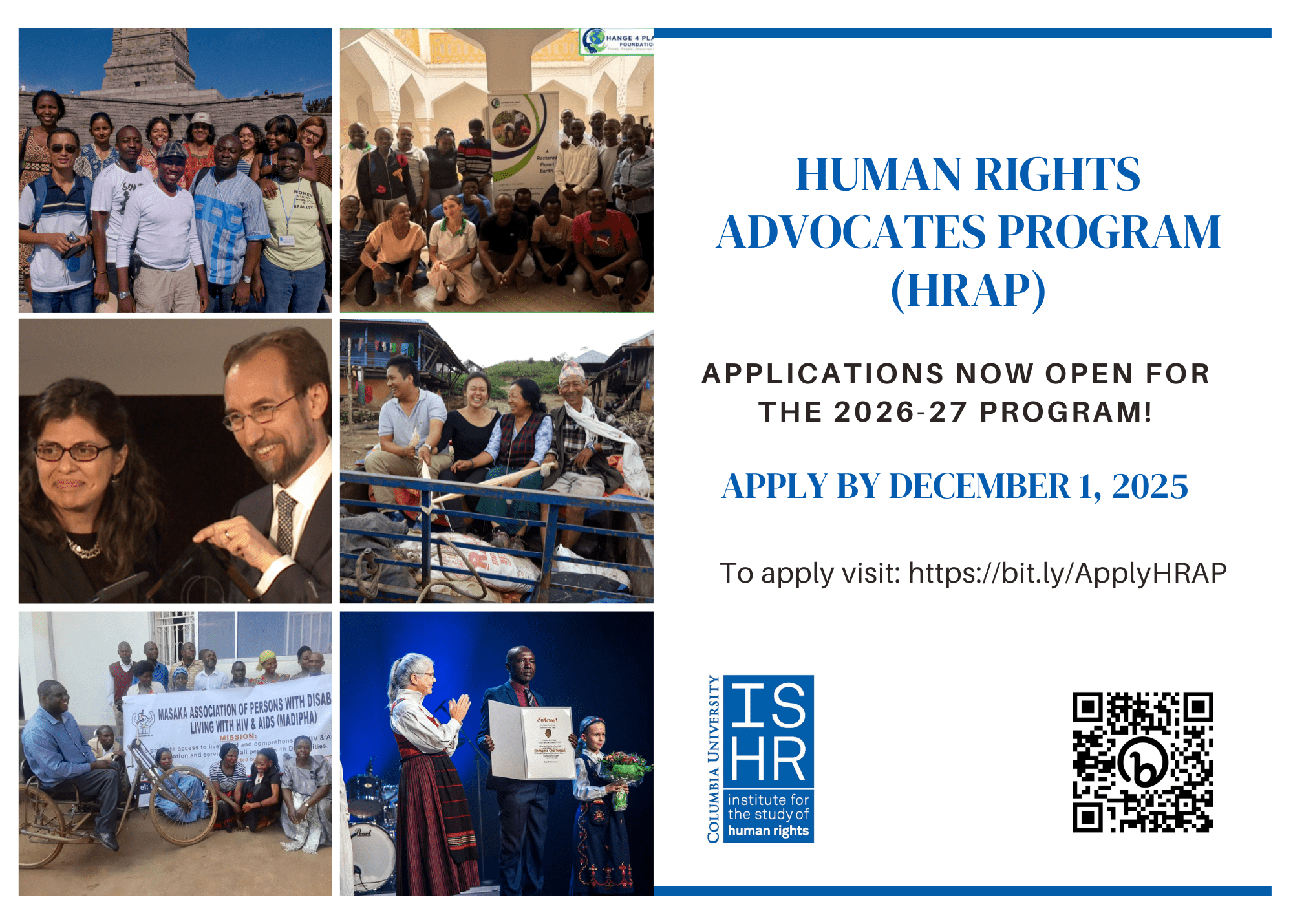
The Human Rights Advocates Program (HRAP) at Columbia University is accepting applications for the 2026–27 cohort. Since 1989, HRAP has leveraged Columbia’s academic resources and New York City’s ecosystem of NGOs and international institutions to equip frontline advocates with graduate-level learning, skills training, mentoring, and powerful networks. More than 350 advocates from nearly 100 countries have completed the program, many now leading organizations, shaping public policy, teaching at universities, and advancing justice on the frontlines.
At a Glance
-
Who should apply: Grassroots human rights advocates working with NGOs on issues such as sexual and gender-based violence, minority and LGBTQI+ rights, labor rights, Indigenous peoples’ rights, migration, health and social exclusion, environmental justice, disability rights, and corporate social accountability.
-
Application deadline: Monday, December 1, 2025 at 11:59 pm ET
-
Status notifications: By April 30, 2026
-
Program schedule: Online component in November–December 2026; on-campus residency mid-January to mid-May 2027 (dates subject to change at ISHR’s discretion)
-
Language: Fluency in English required
-
Degree: Bachelor’s degree preferred but not required
Why HRAP
HRAP is a four-month, capacity-building residency that combines academic coursework, practical workshops, tailored mentoring, and targeted networking. Advocates leave with sharper strategies, stronger organizations, and lasting partnerships that amplify impact at home.
Program Pillars
-
Graduate-Level Coursework
Audit at least two Columbia University courses aligned to your advocacy focus. Classes are available across the School of International and Public Affairs, Columbia Law School, Barnard College, the Mailman School of Public Health, Teachers College, the School of Social Work, and the Graduate School of Arts and Sciences.
-
Skills-Building Workshops
Practitioner-led sessions from leading organizations (including Human Rights Watch and WITNESS) cover fundraising and organizational sustainability, campaign strategy, research and documentation, media relations, editorial and op-ed writing, effective presentations, stress and trauma management, UN and government advocacy, and video advocacy.
-
Networking and Advocacy
Curated meetings with NGOs, international institutions, foundations, donors, and policymakers in New York City, plus a focused advocacy and networking trip to Washington, D.C. Opportunities often lead to collaborations, funding prospects, and joint projects.
-
Faculty Mentoring
Each Advocate is paired with a Columbia faculty mentor for guidance on advocacy goals, strategic planning, and career trajectory.
Student Life
Advocates reside at International House alongside US and international students and take part in social, cultural, and learning activities within the Columbia community.
Eligibility and Selection
-
Professional background: Applicants must be grassroots advocates working with NGOs. Full-time students, academics, and government officials are not eligible. Applicants with full-time jobs who actively pursue advocacy are preferred.
-
Geographic scope: Applicants from high-income countries are considered only if they represent marginalized communities.
-
Language and education: English fluency is required. A bachelor’s degree is preferred but not mandatory.
-
Organizational endorsement: Applicants must provide proof of institutional endorsement in English and commit to returning to their organization after the program.
Selection criteria include demonstrated human rights experience, commitment to the field, and readiness to succeed in graduate-level study. Preference is given to candidates with limited prior opportunities to study or travel internationally.
Funding
ISHR undertakes a rigorous selection process, then makes every effort to secure funding for shortlisted Advocates. In some cases where funding cannot be secured, shortlisted candidates may be asked to source their own support to attend.
How to Apply
- Please go to the Admissions page to apply.
-
Create an account on the ISHR website and log in.
-
From the menu, choose Start/Resume a HRAP Application.
-
Complete all sections in English, upload required attachments, and follow all on-screen and emailed instructions.
-
You may save as draft and return later, or submit when complete.
-
A confirmation email will be sent upon submission. Until the deadline, you may log in to view or edit a submitted application via Manage HRAP Submission.
-
Accessibility: Columbia University strives to make web content accessible. If you encounter difficulties, email ishr@columbia.edu.
Late applications are not accepted, including in cases of applicant-side technical issues. Apply well in advance of the deadline.
Required Documents
-
Two signed letters of recommendation in English with recommender contact details (phone and email). Electronic signatures are accepted. Unsigned letters will result in removal from consideration. Letters must come from individuals who can attest to your advocacy work. If you have external funding, at least one letter from a donor is strongly recommended.
-
Proof of institutional endorsement in English from your organization. This is separate from your two recommendation letters.
-
Academic credential: Upload a copy of your university diploma and/or transcript (highest degree if multiple).
Due Diligence and Interviews
Shortlisted applicants will interview with HRAP alumni from their country or region. Finalists interview with ISHR’s Director of Capacity Building. This stringent vetting ensures alignment with HRAP’s mission and standards.
Key Dates
-
Applications close: Monday, December 1, 2025 at 11:59 pm ET
-
Status notifications: By April 30, 2026
-
Program timeline: Online Nov–Dec 2026; on-campus mid-Jan–mid-May 2027 (subject to change)
Alumni Impact and Ongoing Support
HRAP alumni have gone on to lead major NGOs, advise governments and UN bodies, publish in leading journals, and build cross-regional coalitions. ISHR continues to support alumni through:
-
Scholarship and fellowship alerts
-
Proposal reviews and technical advice that have helped secure significant project funding
-
Alumni-led workshops and peer learning
-
Visibility opportunities via talks, media, and the HRAP YouTube channel
-
Student volunteer placements with alumni organizations
Frequently Asked Questions
Am I eligible to apply?
You must be a grassroots advocate working with an NGO. Full-time students, academics, and government officials are not eligible.
Are advocates with disabilities eligible?
Yes. HRAP welcomes advocates with disabilities who meet the program’s criteria.
I don’t currently work for an NGO but intend to. Can I apply?
Current, demonstrated NGO-based advocacy experience is required.
What counts as a high-income country exception?
Applicants from high-income countries may be considered if they represent marginalized communities.
Can I reapply if I was not selected previously?
Yes. Reapplications are welcome.
Will HRAP cover my living expenses?
ISHR strives to secure funding for shortlisted Advocates; in some cases, candidates may need to secure their own funding.
Can I edit my application after submitting?
Yes, until the deadline, via Manage HRAP Submission.
Must I submit institutional endorsement?
Yes. Institutional endorsement is required and is separate from your two recommendation letters.
Who should sign the institutional support letter if I am the director?
Another authorized leader (e.g., board chair or senior officer) should sign on behalf of the organization.
Can recommenders be from my current organization?
Yes, provided they can objectively attest to your advocacy and include full contact details.
Can I defer my admission to the following year?
Deferrals are not guaranteed. Admission and scheduling are at ISHR’s discretion.
(See the Frequently Asked Questions for more information).
Tips to Strengthen Your Application
-
Be specific: Quantify your impact, communities served, policies influenced, or cases supported.
-
Show organizational fit: Explain how HRAP will strengthen your organization’s strategy and services.
-
Map your learning plan: Identify Columbia courses and workshops aligned to your goals.
-
Plan knowledge transfer: Describe how you will apply skills and networks post-program.
-
Secure strong referees: Choose recommenders who can provide detailed, timely letters.
-
Apply early: Build in time for document collection and any accessibility accommodations.
Accessibility
Columbia University aims to make all websites accessible. If you experience difficulty using the application pages, contact ishr@columbia.edu.
Call to Action
Prepare your documents, confirm your eligibility, and submit your application before December 1, 2025 at 11:59 pm ET. Visit https://www.humanrightscolumbia.org/hrap to find out more








Comments are off for this post.