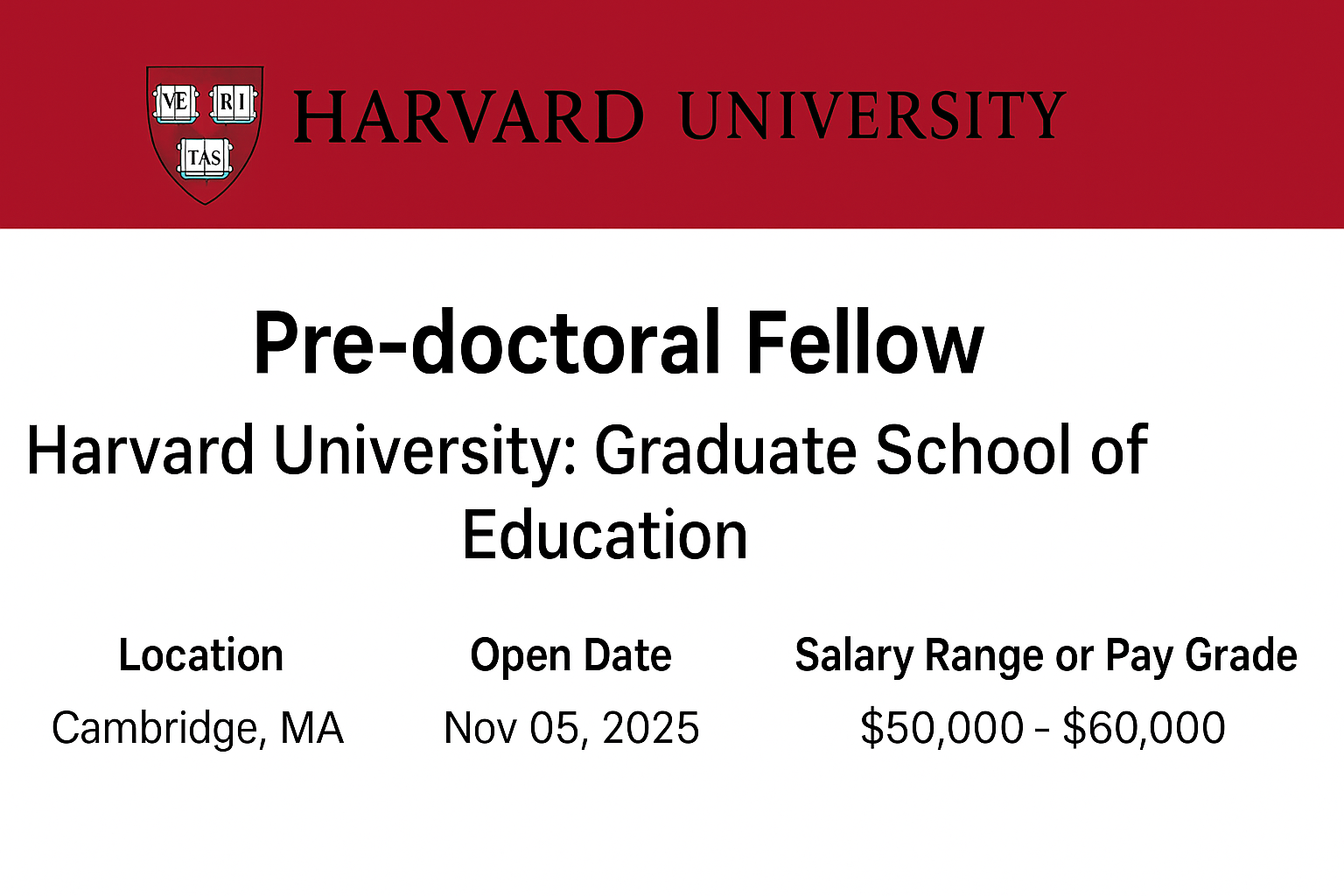
The Embedded Development Lab at the Harvard Graduate School of Education (HGSE) is hiring two full-time Pre-doctoral Fellows. The first to start in January 2026, the second to start around July 2026, each for an initial 12 month period with possibility of extension. Founded in 2025, the Embedded Development Lab uses the tools of economics to study paths of development that are championed by the specific people embedded in the places where they dwell. Our current research aims to extend and scale educational approaches that empower communities to become agents of their own development, with a current focus on teacher professional development in sub-Saharan Africa (and beyond). The “Learning to Learn” framework at the heart of this work envisions an educational process through which populations leverage scientific principles to carry out more careful observations, descriptions and analyses of their own communities. We explore whether this capability, then, helps professionals (such as teachers) and their communities articulate, and advance along, a clearer path of development tied to their place. The Lab works with several partners who introduce this approach to education through schools, teacher professional development, agriculture education, and more.
Fellows will be based at HGSE under the direction of Professor Vesall Nourani. This position offers significant opportunities for travel, often requiring extended stays in low- and middle-income communities to support on-the-ground research activities. Fellows will work closely with large, multidisciplinary research teams and take on key responsibilities in managing the data collection process, including designing surveys, analyzing literature on measurement practices, overseeing data cleaning workflows, and training and supervising enumerators in the field. Additional tasks include leveraging econometrics to analyze large datasets, drafting literature reviews, creating presentations, and editing research papers. This fellowship is designed as an immersive bridge prior to graduate school or industry research roles, providing hands-on preparation for those interested in empirical development and education economics.
We encourage applications from all levels of technical research skills or subject matter knowledge. As an organization focused on economic development through education, we welcome applications from persons with varied backgrounds and perspectives. We strive to create a work environment where our staff are aligned on mission and the broader purpose underlying any project. This allows the perspective and experiences of each staff member to enhance our project activities through the unique and fresh insights they provide to the problems we are trying to solve.
Applicants should have completed a bachelor’s degree or master’s degree, have strong quantitative skills, and experience with empirical research methods. Candidates with research experience are strongly preferred, especially those with programming experience in Stata, R, and/or Python. Candidates need not be Economics majors or degree holders, though they should have a strong interest in and some experience with Economics. Successful candidates have come from a variety of backgrounds (including from undergraduate and graduate programs, industry jobs, and other research assistant positions), and have a range of skill levels and experience with coding. Experience living and working in a low- or middle-income country, especially in a capacity where one contributed to data collection workflows in schools, is valued.
The Pre-doctoral Fellow will play a key role in supporting research projects related to randomized controlled trials of teacher training interventions (in Uganda, with Kimanya Ngeyo Foundation) and long-term educational program evaluations (such as FUNDAEC’s SAT program in Colombia). This position is integral to organizing, cleaning, and analyzing complex datasets, as well as supporting research activities and proposal development. The Fellow will contribute actively to research output and help manage research assistants as needed.
Responsibilities
Data Management & Analysis:
● Organize, clean, and maintain large-scale datasets, and assist with new, complex data collection spanning multiple units of observation and time periods.
● Support data integration/merging across projects and years.
● Prepare datasets for research use, including preliminary data analyses (summary statistics, visualizations, etc.).
● Carry out advanced statistical analyses to support research goals.
● Create and maintain data dictionaries and ensure proper documentation to facilitate team access and understanding.
● Ensure compliance with data protection and ethical standards, particularly when handling sensitive data from developing regions.
● Think thoughtfully and creatively about data to develop new and innovative methods for data collection, management, and analysis.
Research & Project Collaboration:
● Support research design, proposal writing, manuscript development, and the creation of presentations.
● Participate in ongoing and new research activities related to both Ugandan and Colombian education interventions.
● Engage in all required teaching, faculty, and committee activities in-person and as needed by the faculty sponsor.
Survey Programming:
● Program and digitize surveys using an ODK-based data collection platform, ensuring accurate data capture and integration with existing data systems.
● Design and implement (high-frequency) sanity checks to monitor data quality and identify errors promptly.
Collaboration and Communication:
● Work closely with researchers, providing data-related support and expertise.
● Communicate effectively with partners and stakeholders based in developing countries to understand their data needs, existing data systems, and facilitate research collaborations.
● Provide training and support to team members and local partners on data management practices and tools.
This role is based in Cambridge, MA, with up to six months international travel to project sites as needed.







Comments are off for this post.