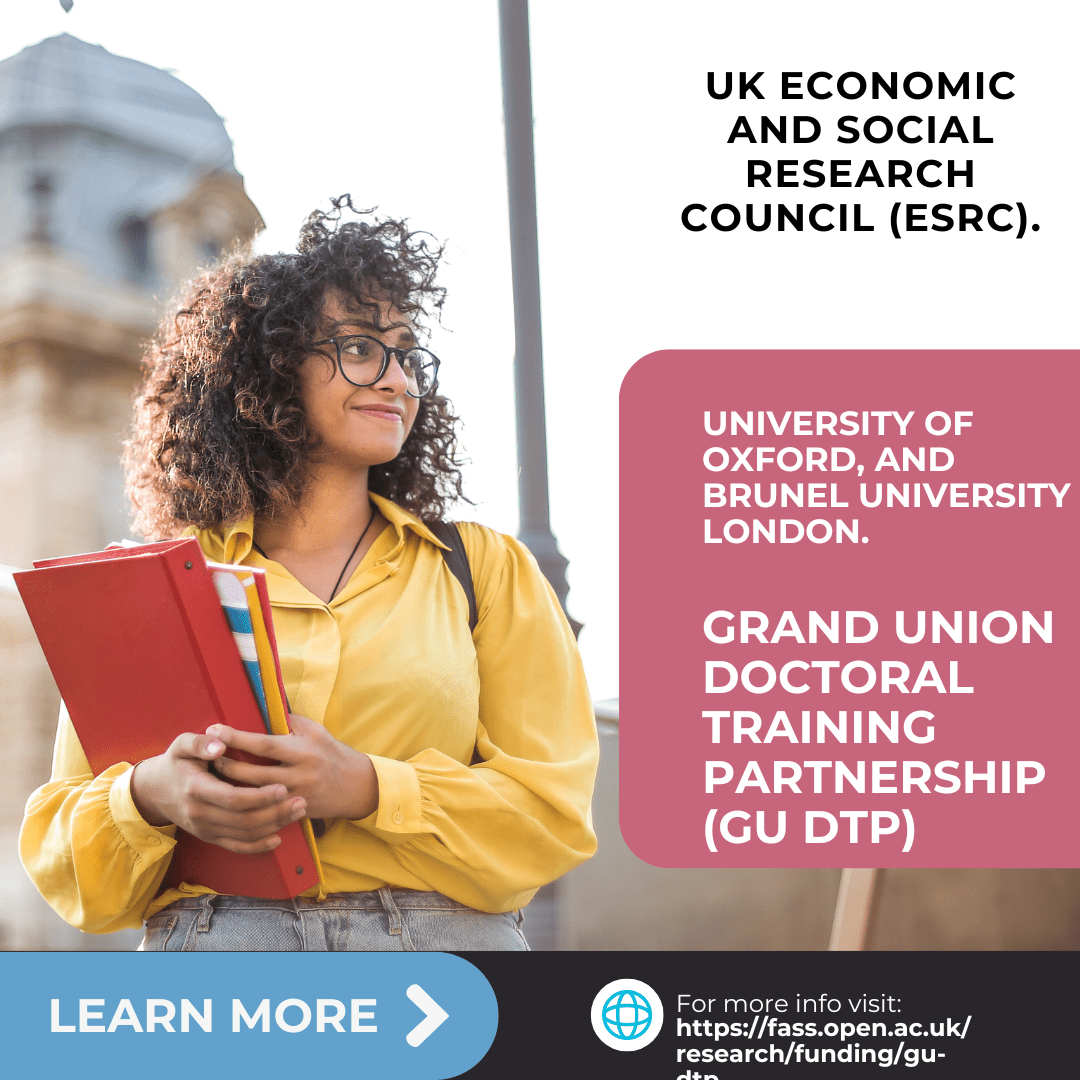
The Grand Union Doctoral Training Partnership (GU DTP) is an elite research and training initiative designed to cultivate the next generation of social science researchers. This partnership brings together the academic strengths of The Open University (OU), the University of Oxford, and Brunel University London, creating a dynamic platform for doctoral students to pursue high-quality research in an interdisciplinary, collaborative environment.
Table of Contents
- About the Grand Union Doctoral Training Partnership
- Pathways and Research Areas
- 1. Development Policy and Practice (DPP) Pathway – The Open University
- 2. Geography and Environmental Studies Pathway – The Open University (Lead University: Oxford)
- 3. Innovation in Learning Pathway – Faculty of Wellbeing, Education, and Language Studies, OU
- 4. Health and Wellbeing Pathway – Faculty of Wellbeing, Education, and Language Studies, OU (Lead University: Brunel)
- 5. Psychology Pathway – Faculty of Arts and Social Sciences, OU
- 6. Organisation, Leadership, and Governance Pathway – Faculty of Business and Law, OU
- 7. Social Justice and Inequalities Pathway – Faculty of Arts and Social Sciences, OU
- Benefits of Joining the GU DTP
- Award Structures
- Application Process
- How to Apply
- Support for Applicants
- Key Contacts
- Why Choose the Grand Union DTP?
- Final Thoughts
The GU DTP focuses on nurturing research talent across 23 subject areas, grouped into five broad clusters, offering structured support for both full-time and part-time doctoral candidates. It emphasizes academic excellence, professional development, and the creation of distinctive, globally impactful doctoral theses.
About the Grand Union Doctoral Training Partnership
The GU DTP is part of the Economic and Social Research Council (ESRC) Doctoral Training Partnership network, which funds and supports postgraduate researchers across the United Kingdom. By combining the strengths of three leading institutions—OU, Oxford, and Brunel—the partnership provides a unique doctoral experience that extends beyond traditional university programs.
Through the GU DTP, doctoral candidates gain access to:
- Bespoke training programs tailored to their research discipline.
- Placement opportunities and research collaborations with partner institutions.
- International and cross-institutional networking with academics and peers.
- Resources and facilities across three world-class universities.
The partnership embodies a commitment to producing highly skilled researchers equipped for careers in academia, industry, and public policy.
Pathways and Research Areas
The GU DTP supports a wide range of doctoral research in social sciences through specialized pathways. Each pathway offers expert supervision, targeted training, and opportunities for interdisciplinary collaboration.
1. Development Policy and Practice (DPP) Pathway – The Open University
Pathway Leads: Dr Mark Lamont & Dr Frangton Chiyemura
Focus: This pathway emphasizes participatory and inclusive approaches to development. It challenges conventional “top-down” models of policy and promotes innovative solutions for global issues such as:
- Sustainable energy and infrastructure
- Migration and human security
- Climate change adaptation
- Food systems, health, and education
Doctoral candidates benefit from a strong policy-practice orientation, gaining skills to influence both local and international development outcomes.
2. Geography and Environmental Studies Pathway – The Open University (Lead University: Oxford)
Pathway Lead: Dr Carry Van Lieshout
Focus: This pathway investigates human-environment interactions, spatial inequalities, and environmental challenges. Research is supported by the OpenSpace Research Centre, fostering interdisciplinary collaboration and applied research. Key areas include:
- Environmental sustainability
- Urban and rural development
- Climate adaptation strategies
- Human geography and social impact studies
Students in this pathway are encouraged to engage in innovative research that bridges academic theory with practical environmental solutions.
3. Innovation in Learning Pathway – Faculty of Wellbeing, Education, and Language Studies, OU
Pathway Lead: Dr Margaret Ebubedike
Focus: Innovation in Learning covers diverse topics in educational research, including:
- Technology-enhanced learning and digital literacies
- Creative teaching and informal learning contexts
- Inclusion, equity, and well-being in education
- Learning analytics and emerging education technologies
Candidates explore interdisciplinary approaches to address educational challenges, particularly in disadvantaged or marginalized communities.
4. Health and Wellbeing Pathway – Faculty of Wellbeing, Education, and Language Studies, OU (Lead University: Brunel)
Pathway Lead: Dr Justin Rogers
Focus: This pathway equips doctoral researchers to tackle complex health and social care issues. Key research themes include:
- Mental health and disability
- Ageing and later life
- Reproductive and sexual health
- Care provision and family well-being
The pathway emphasizes participatory research methods, ensuring that the voices of patients, carers, and service users are central to inquiry.
5. Psychology Pathway – Faculty of Arts and Social Sciences, OU
Pathway Leads: Dr Sandra Obradovic & Dr Ailsa Strathie
Focus: Psychology research spans individual cognition, social behavior, and public policy implications. Students explore topics such as:
- Health and well-being psychology
- Social cognition and group behavior
- Forensic psychology and legal decision-making
- Learning, memory, and developmental psychology
Through engagement with the Open Psychology Research Centre, students gain advanced skills in empirical research and interdisciplinary collaboration.
6. Organisation, Leadership, and Governance Pathway – Faculty of Business and Law, OU
Pathway Lead: Dr Inge Hill
Focus: This pathway focuses on the structures, ethics, and practices of organizations and leadership. Key areas include:
- Governance, sustainability, and social responsibility
- Gender and leadership studies
- Employment, labor, and economic policy
- Digital transformation and entrepreneurship
Students have access to specialized research centers, including the Centre for Policing Research and Learning and the Open Justice Centre, for applied research and policy engagement.
7. Social Justice and Inequalities Pathway – Faculty of Arts and Social Sciences, OU
Pathway Leads: Dr Dan Taylor & Dr Victoria Cooper
Focus: This pathway addresses inequality and social justice challenges through interdisciplinary research. Topics include:
- Policy and social work interventions
- Global inequalities and human rights
- Community-based research and co-production of knowledge
Students engage with the Global Challenges and Social Justice (GCSJ) Research Centre, fostering applied research with tangible societal impact.
Benefits of Joining the GU DTP
Being part of the Grand Union DTP offers extensive benefits for doctoral candidates:
- Structured funding: Most ESRC studentships provide 3.5 to 4 years of full-time funding, including compulsory placements and specialist training.
- Professional development: Training in research methods, leadership, communication, and knowledge exchange.
- Global collaboration: Opportunities for joint research projects with academics from Oxford, Brunel, and OU.
- Access to resources: Shared facilities, libraries, and research infrastructure across partner universities.
- Career readiness: Graduates develop critical skills applicable to various roles, including academic, government, industry, and NGO settings.
Award Structures
The GU DTP provides flexible award structures to meet the training needs of students with varying prior academic backgrounds:
- +3.5 years: Standard PhD studentship including a 3-month Research in Practice placement. Suitable for students who have completed core training.
- +3.75 years: PhD funding, including placement and additional core or advanced training.
- +4 years: Full-length award to complete both core and advanced training during the program.
All studentships commence in October 2025 and include access to research placements and international study opportunities.
Application Process
Applying to the GU DTP involves a three-stage process:
- Institutional Selection: The OU reviews applications based on the GU application form, OU application form, and interview performance.
- GU Review: Applications are evaluated by the Grand Union DTP selection panels, ensuring merit-based competition across all partner institutions.
- Award Determination: Final selection and communication to successful candidates, usually between April and June, with reserve lists for withdrawals.
How to Apply
Step 1: Make informal contact with potential supervisors at OU to discuss your research proposal.
Step 2: Complete the OU application form and indicate your interest in GU DTP funding under “Funding.”
Step 3: Complete the GU DTP application form, including:
- Research proposal or project description
- Curriculum Vitae
- Academic transcripts and degree certificates
- English language proficiency certificates (if applicable)
- References from two independent academics or professionals
Step 4: Submit all documents via email to FASS-PhD-Applications@open.ac.uk by 7 January 2025 (midday UK time).
Step 5: Ensure all forms, translations, and supporting documents are complete, accurate, and submitted on time. Incomplete or late applications are not assessed.
Support for Applicants
The OU and GU DTP provide extensive support to applicants, including:
- Guidance on identifying potential supervisors
- Webinars and information sessions about research pathways
- Application checklists and FAQs
- Advice on preparing research proposals and motivation statements
Candidates are encouraged to engage early with faculty leads to maximize their chance of success.
Development Policy and Practice (DPP) Pathway: Dr Mark Lamont, Dr Frangton Chiyemura
Geography and Environmental Studies: Dr Carry Van Lieshout
Innovation in Learning: Dr Margaret Ebubedike
Health and Wellbeing: Dr Justin Rogers
Psychology: Dr Sandra Obradovic, Dr Ailsa Strathie
Organisation, Leadership and Governance: Dr Inge Hill
Social Justice and Inequalities: Dr Dan Taylor, Dr Victoria Cooper
For all application queries: FASS-PhD-Applications@open.ac.uk
Why Choose the Grand Union DTP?
The Grand Union Doctoral Training Partnership offers:
- A world-class academic environment
- Collaborative research opportunities across leading UK universities
- Specialized training in research methods, communication, and policy engagement
- Global mobility opportunities for placements and international collaboration
- A platform to develop high-impact, interdisciplinary research with real-world applications
Doctoral candidates gain skills that are highly valued both within and outside academia, from policy development and research consultancy to leadership roles in NGOs, government, and international organizations.
Final Thoughts
The Grand Union DTP represents a transformative opportunity for aspiring researchers, combining world-class supervision, tailored training, and interdisciplinary collaboration. Through this program, students can achieve academic excellence, develop professional expertise, and make meaningful contributions to society, policy, and the global knowledge base.
Application Deadline: 7 January 2026 (midday UK time)
Start of Studies: October 2025
For more information and opportunities, visit The Open University Grand Union DTP page
: opportunitiesforwomen.org/







Comments are off for this post.