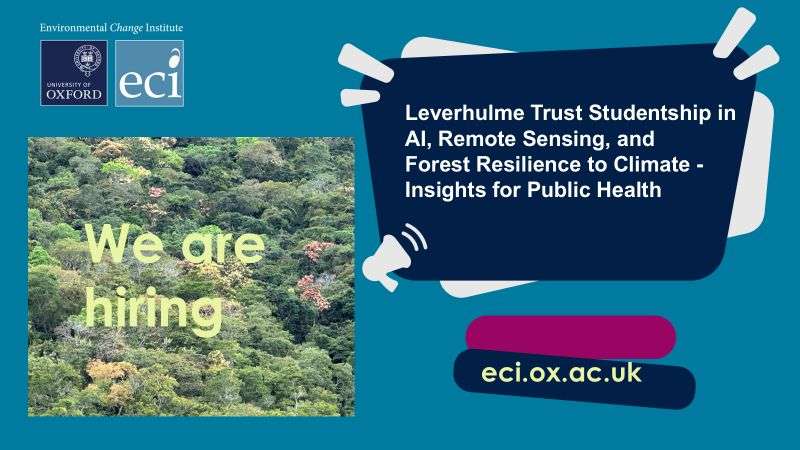
The University of Oxford is inviting applications for a fully funded doctoral studentship supported by the Leverhulme Trust, beginning in April 2026. This opportunity will be based at the Environmental Change Institute (ECI) within the School of Geography and the Environment (SoGE), and hosted by the Biodiversity and Earth Observation (BioEO) group.
The Leverhulme Trust Studentship is titled:
AI, Remote Sensing, and Forest Resilience to Climate – Insights for Public Health.
This project brings together advanced technologies and interdisciplinary research to explore how climate-driven stresses affect tropical forests and the public health outcomes linked to them. It provides an exceptional opportunity for researchers to study the intersections of climate change, forest ecology, artificial intelligence, and human health.
Project Overview
The project will focus on the Amazon rainforest, one of the most biodiverse and climate-critical ecosystems in the world. Climate-driven stresses such as drought and heat are reshaping forest functional strategies. The doctoral research will investigate how these ecological shifts intersect with public health outcomes and socio-economic vulnerability across municipalities.
Key aspects of the project include:
-
Integration of functional ecology, remote sensing, and artificial intelligence with epidemiology and socio-environmental modelling.
-
Mapping of forest functional strategies using data from permanent plots, UAV and satellite spectral time series, and environmental covariates.
-
Reconstruction of multi-decadal changes in forest function using archives such as Landsat and Sentinel.
-
Linking ecological changes with disease incidence and public health challenges in the Amazon.
Research Objectives
The studentship has four main objectives:
-
Characterise tree functional strategies using trait datasets and permanent plots, and develop AI/ML models to predict these strategies from UAV and satellite spectra combined with climate, hydrology, and soil data.
-
Reconstruct multi-decadal shifts in forest functional strategies using harmonised Landsat-Sentinel datasets, while testing how agrarian economic contexts (Techno-productive Trajectories) influence climate-forest relationships.
-
Model associations between shifts in forest strategies and disease outcomes such as dengue, malaria, leishmaniasis, Chagas, schistosomiasis, leptospirosis, hantavirus, and others.
-
Evaluate socio-economic vulnerability to identify contexts in which risks between forest change and health outcomes are either amplified or reduced.
Supervisory Team
The doctoral student will be supervised by a team of international experts:
-
Dr Jesús Aguirre Gutiérrez (Titular Associate Professor, BioEO, University of Oxford) – Primary Supervisor
-
Dr Andre Acosta (BioEO, University of Oxford)
-
Dr Milton Barbosa (BioEO, University of Oxford and Universidade Federal de Minas Gerais, Brazil)
-
Dr Claudia Torres Codeço (FIOCRUZ, Brazil)
This team provides expertise in ecology, AI, epidemiology, and socio-environmental systems, ensuring an interdisciplinary and comprehensive research environment.
Studentship Details
-
Start date: 1 April 2026
-
Mode of study: Full-time only
-
Eligibility: Open to both Home (UK) and International applicants
-
Funding: Covers full University fees and maintenance stipend at least at the standard UK doctoral rate for up to three years. Final amounts and any additional allowances will be confirmed upon offer.
Training and Development Opportunities
-
Access to doctoral training provided by the School of Geography and the Environment (SoGE) and the Environmental Change Institute (ECI).
-
Participation in the BioEO laboratory, the Leverhulme Centre for Nature Recovery, and associated project workshops.
-
Use of high-performance computing resources and access to large geospatial datasets (UAV imagery, Sentinel-2, Landsat, TerraClimate/ECOSTRESS, health and socio-economic datasets).
-
Support for reasonable research, travel, and fieldwork costs.
-
College membership at one of Oxford’s colleges (confirmed at offer stage).
Eligibility Requirements
Applicants should demonstrate:
-
A master’s degree with distinction (or distinction in dissertation at minimum) in Geography, Environmental or Plant Sciences, Ecology, Remote Sensing, Data/Computer Science, Epidemiology, or related fields.
-
A first-class or strong upper second-class undergraduate degree in any discipline.
-
Strong quantitative and programming skills (R required, Python desirable).
-
Experience with GIS/remote sensing workflows and large datasets.
-
Interest in tropical forest ecology and links with public health.
Desirable Skills and Experience
-
Machine learning and deep learning methods.
-
Trait-based ecology or epidemiological modelling.
-
Tropical fieldwork experience.
-
Strong aptitude for computational and data-driven research.
Applicants from underrepresented backgrounds and communities are especially encouraged to apply.
Application Process
Applications must be submitted via the University of Oxford’s online graduate admissions system: www.ox.ac.uk/admissions/graduate
When applying:
-
Course: Select “DPhil in Geography and the Environment.”
-
Proposed Supervisor: Dr Jesús Aguirre Gutiérrez.
-
Research Title: “AI, Remote Sensing, and Forest Resilience to Climate – Insights for Public Health.”
-
Reference Code: Enter “26SOGE01” in the departmental funding tab.
-
Research Proposal: Provide a statement outlining your fit for the project, how you would shape it, and whether you would emphasise ecology/remote sensing, AI methods, or health modelling.
Please note: Word limits for application documents are strictly enforced. Submissions exceeding the limits will be filtered out automatically.
Applicants selected for interview will receive guidance on the process, with interview questions shared in advance.
Deadline for Applications
Conclusion
The Leverhulme Trust Studentship in AI, Remote Sensing, and Forest Resilience to Climate – Insights for Public Health at the University of Oxford is a prestigious, fully funded opportunity for doctoral study. Combining advanced technologies such as artificial intelligence with pressing questions in tropical forest ecology and public health, the project offers a unique platform for impactful, interdisciplinary research.
With full financial support, access to cutting-edge resources, and guidance from a world-class supervisory team, this studentship provides an exceptional pathway for emerging researchers committed to addressing global challenges at the intersection of environment, health, and technology.
For more Information and Applications:
Visit HERE
Stay on opportunitiesforwomen.org/ for more opportunities.





Comments are off for this post.