Trainees in the positive action programme will receive a monthly grant of €2 214.51 net.
Find out more from our trainees!
Personalised support
As soon as trainees are selected, we get in touch with them to discuss any specific needs they have and ensure that they have all the necessary software, hardware, or ergonomic equipment from the start of their traineeship.
Examples of reasonable accommodation available in the Council:
a personal assistant to navigate the building
text-to-speech and speech-to-text software
braille display
ergonomic support
There is no one-size-fits-all solution. To provide the appropriate accommodation, a case-by-case examination is therefore needed.
We are also in touch with the team that hosts the trainees in order to prepare for their arrival and welcome.
How to apply
Traineeships are offered twice a year, with each traineeship lasting five months:
1 February to 30 June (first period)
1 September to 31 January (second period)
Applications are open for a limited period several months before the start of the traineeship period.
The application procedure for the positive action programme is the same as the main traineeship programme. Find out more on the following page:
After you fill in the application and before the closing date of the online application period, you need to send documents proving your disability to PAPTD@consilium.europa.eu. The proof can be:
a document issued by a national or regional authority or an accredited body in a Member State of the EU;
an EU disability card;
a certificate issued by a medical doctor less than six months ago.
If you have a doctor’s certificate, it must:
have been issued in a Member State of the EU and be not more than six months old;
state clearly the condition which the medical doctor considers a disability and include confirmation from the signing medical doctor that, to the best of their understanding, the condition in question is a long-term physical, mental, intellectual or sensory impairment.
Testimonials
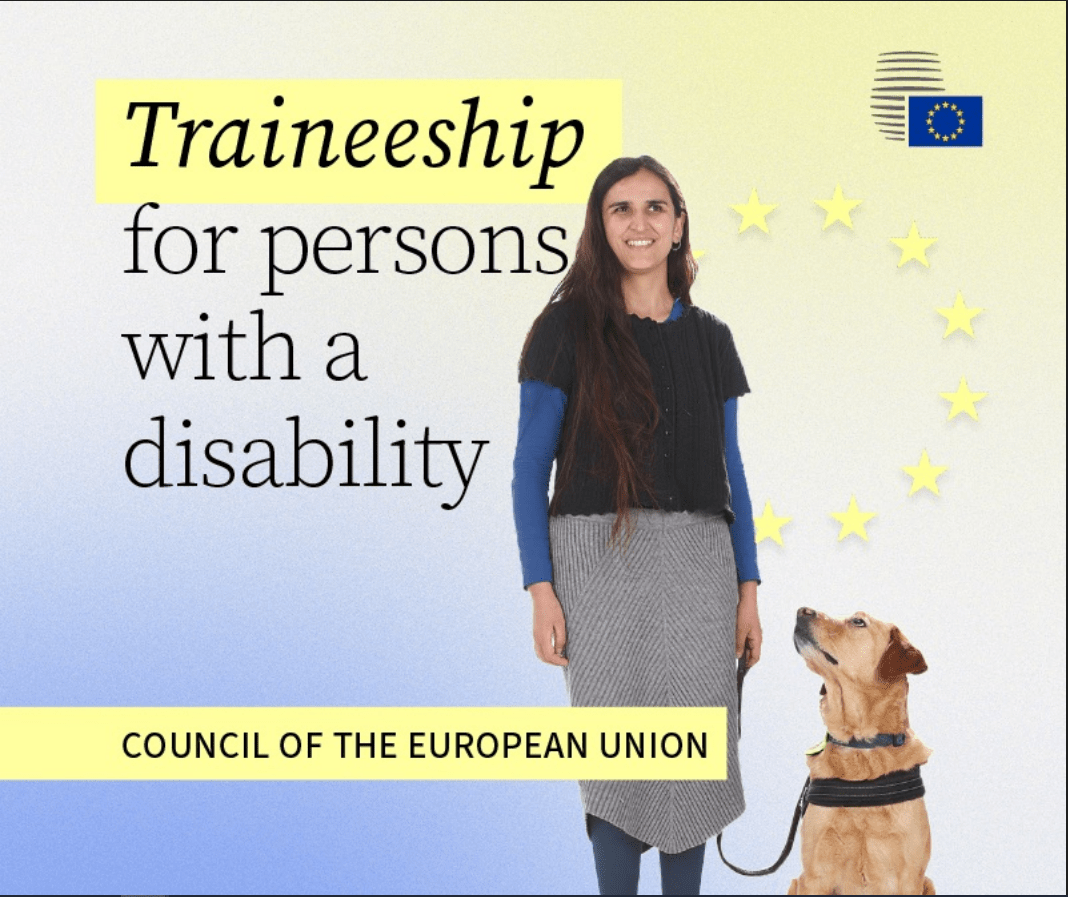
Between 2020 and 2024, 25 trainees with physical, mental, intellectual and sensory impairments worked in different teams at the Council.
Everybody at the Council has been incredibly kind, warm and welcoming. I think as a next step it would be important to normalise people with disabilities working at the Council, both as trainees and as members of staffLisa
Blindness has never affected my decisions, and I have always sought to transform my limits into opportunities, and everybody at the Council understood and even supported that.Anna Rita
This initiative (which started as a pilot project in 2020) was recently awarded the European Ombudsman Award for excellence in public administration in the category ‘Excellence in diversity and inclusion’. The Council is one of the few EU institutions which offers such a programme.
Contact
For more information you can contact the traineeships office:







Comments are off for this post.