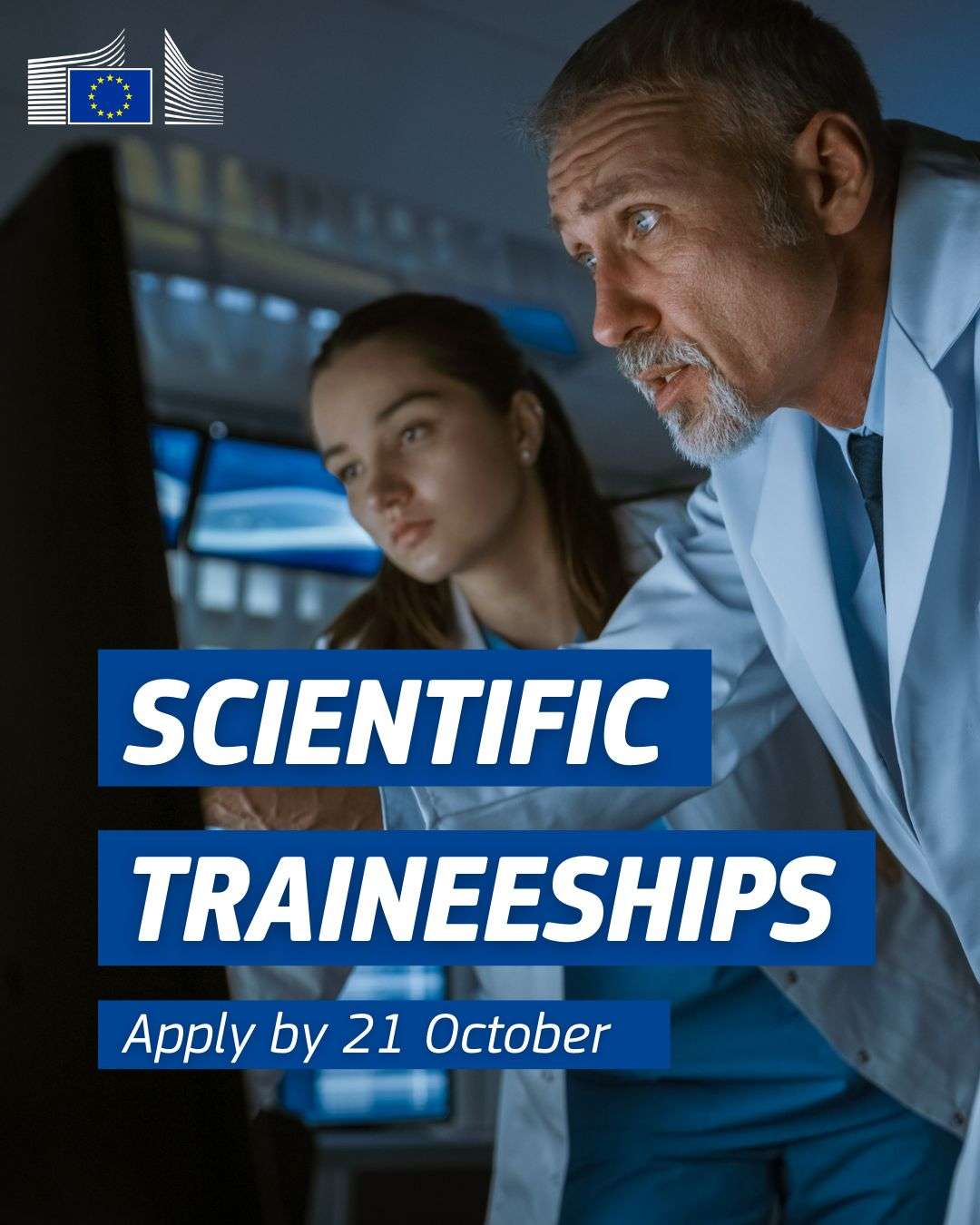
The European Commission’s Joint Research Centre (JRC) is now accepting applications for its March 2026 Scientific Traineeship Programme. This prestigious programme offers graduates and young researchers a fully funded opportunity to work in an international research environment, contribute to EU policymaking, and gain valuable professional experience.
About the Joint Research Centre
The Joint Research Centre (JRC) is the science and knowledge service of the European Commission. Its mission is to provide independent, evidence-based knowledge to support EU policies that have a direct impact on European society. With sites in Belgium, Germany, Italy, the Netherlands, and Spain, the JRC carries out cutting-edge research across fields such as climate, energy, health, security, digital transformation, and innovation.
Why Apply for the JRC Traineeship Programme
The JRC traineeships are paid positions that provide both financial and professional benefits. Participants will:
-
Receive a monthly allowance between €1,297 and €1,663, depending on the location.
-
Benefit from a travel allowance to help cover relocation costs.
-
Work on meaningful projects that support EU and global policy development.
-
Gain hands-on experience in both research and policy-related tasks.
-
Build an international professional network in a multicultural and interdisciplinary environment.
This makes the JRC Scientific Traineeship Programme a fully funded opportunity, ideal for graduates looking to develop their careers in science, research, and policymaking.
Fields of Research Available
For the March 2026 intake, the JRC will recruit approximately 50 trainees across 11 fields:
-
Environment and climate
-
Energy sustainability
-
Security, ICT, cybersecurity and technologies for law enforcement
-
Data management and evidence-based decision-making
-
Artificial intelligence, machine learning and complex systems
-
Space technologies, secure connectivity and geo-information
-
Health and consumer protection
-
Transport science and sustainable mobility
-
Social and political sciences, geopolitics, democracy, economic and financial resilience
-
Behavioural science, research management, economics and education
-
Nuclear science and technology, radiochemistry and radiation protection
Eligibility Criteria
Applicants must meet the following requirements:
-
Nationality: Open to EU citizens and nationals of countries associated with EU Research Framework Programme..
-
Education: Minimum of a three-year higher education degree (Bachelor’s or equivalent, 180 ECTS). Candidates must have graduated within the past five years or be currently enrolled in a Master’s or PhD programme.
-
Languages: Excellent knowledge of English (C1 level CEFR). EU nationals must also demonstrate a good command of another EU language (minimum B2).
-
Experience Restrictions: Candidates must not have completed more than six weeks of prior traineeship, work, or contractual positions within EU institutions.
Selection Process
Applications are assessed anonymously based on:
-
Education and academic background.
-
Language proficiency.
-
Relevant professional, research, or volunteering experience.
-
IT and technical knowledge.
-
International exposure such as studies or work abroad.
-
Publications, conferences, or academic contributions.
-
Motivation and alignment with JRC’s goals.
Key Traineeship Details
-
Start date: March 2026
-
Duration: 5 months (full-time)
-
Allowance: €1,297 to €1,663 per month depending on location
-
Additional funding: Travel allowance provided as a fixed lump sum
-
Locations: JRC sites: Geel (Belgium), Ispra (Italy), Karlsruhe (Germany), Petten (the Netherlands) or Seville (Spain).
-
Work model: On-site with limited teleworking options
Application Deadline
The deadline to apply is October 21, 2025 at 15:00 Brussels time. Late applications will not be accepted, and candidates are strongly advised to apply early to avoid technical issues close to the deadline.
How to Apply
Applications must be submitted through the official European Commission traineeship portal. Full details on the research fields, candidate profiles, and conditions are available in the official vacancy notice on the JRC website.
APPLY NOW
Conclusion
The European Commission JRC Scientific Traineeship Programme is a fully funded traineeship that combines a paid allowance, relocation support, and access to world-class research projects. It is an outstanding opportunity for young graduates and researchers to gain international experience, build expertise, and contribute to shaping the future of European policy.
Applications for the March 2026 intake are open until October 21, 2025.
Rules governing the scientific traineeship programme in the JRC, English (593 KB – PDF)





Comments are off for this post.