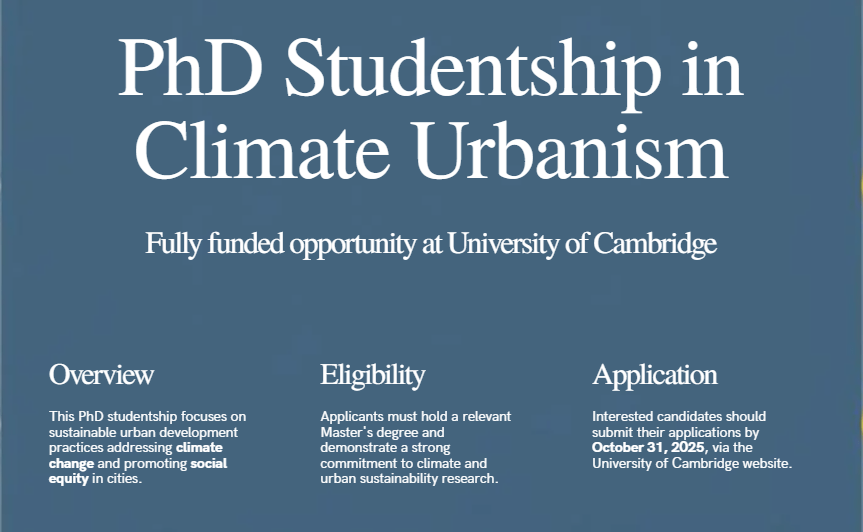
The University of Cambridge, in collaboration with Anglia Ruskin University (ARU), is delighted to announce a fully funded 3.5-year PhD studentship as part of the ESRC Cambridge Doctoral Training Partnership (CAM-DTP). Starting in October 2026, the project will investigate the critical question: Does climate urbanism, in its current form, primarily sustain the lifestyles of the affluent while marginalising vulnerable groups?
This timely research will be supervised by Dr. Charlotte Lemanski (University of Cambridge, Department of Geography) and Dr. Rosie Robison (Global Sustainability Institute, ARU, Cambridge campus). It offers a unique opportunity to engage with urgent debates at the intersection of urban sustainability, climate justice, and social inequality.
Research Focus
Urban centres worldwide are at the forefront of the push toward net zero. Policies such as promoting renewable energy, retrofitting housing, encouraging cycling, and developing 15-minute cities are heralded as pathways to more sustainable futures. However, emerging critiques—captured in the idea of climate apartheid—suggest that these strategies may disproportionately benefit privileged groups, protecting their lifestyles and assets while sidelining those already disadvantaged.
The PhD will interrogate this tension through comparative case studies in the UK and South Africa. The research will explore how sustainability interventions—such as transport innovations, water reuse systems, and energy transitions—can reinforce or challenge existing inequalities. By focusing on both affluent and marginalised urban communities, the project seeks to reveal whether “climate urbanism” is unintentionally reproducing inequality under the banner of sustainability.
Methodological Approach
The project is rooted in qualitative research methods, providing rich insights into lived experiences, policies, and practices. Possible approaches include:
-
In-depth interviews with residents, policymakers, and community stakeholders.
-
Policy analysis of urban sustainability frameworks in the UK and South Africa.
-
Workshops to bring together diverse perspectives and co-produce knowledge.
-
Ethnography to capture the everyday realities of urban sustainability initiatives.
There is significant flexibility in how the project is designed, allowing the successful applicant to focus on specific sectors—such as energy, water, or transport—that align with their interests and expertise. Local institutional support will be provided for the South Africa fieldwork.
Supervisory Support and Training
The successful candidate will benefit from dual affiliation:
-
The Department of Geography, University of Cambridge, renowned for its excellence in human geography and urban studies.
-
The Global Sustainability Institute (GSI), ARU, which specialises in interdisciplinary approaches to sustainability challenges.
Together, these institutions will provide a supportive, intellectually stimulating environment. Students will also be part of the wider CAM-DTP training programme, which offers world-class research training, skills development, and opportunities for networking across the social sciences.
Funding and Benefits
The studentship provides:
-
Full tuition fees at the University of Cambridge.
-
A generous maintenance stipend aligned with UKRI rates, for 3.5 years.
-
Research and training expenses, including support for international fieldwork in South Africa.
This package ensures the successful candidate can focus fully on developing their doctoral research and academic career.
Application Process
The deadline for applications is Tuesday, 2 December 2025. Shortlisted candidates will be invited to attend online interviews on 16 January 2026. CLICK HERE to apply.
Interested applicants are strongly encouraged to contact the supervisory team in advance to discuss their ideas and ensure a strong application. Informal enquiries can be directed to:
To support potential applicants, the supervisory team will hold online drop-in sessions on:
-
Friday, 24 October 2025
-
Monday, 17 November 2025
Guidance on preparing your application will also be shared with those who register their interest.
For detailed information about eligibility, funding, and how to apply, please visit:
Who Should Apply?
This studentship is ideal for highly motivated Master’s students or recent graduates with a strong interest in urban studies, sustainability, and social justice. Applicants should have:
-
A relevant academic background in geography, sociology, environmental studies, urban planning, or related fields.
-
A passion for understanding how urban sustainability policies intersect with inequality.
-
The drive to undertake independent research and contribute to academic debates on climate justice.
Conclusion
The urgency of climate change demands bold and equitable solutions. This PhD studentship offers a unique opportunity to examine whether current sustainability strategies truly serve everyone—or primarily the privileged few. By investigating these dynamics across two very different national contexts, the research will provide critical insights for policymakers, practitioners, and communities alike.
Applications are now open—join us in shaping the future of climate justice in urban environments.
Application deadline: 2 December 2025
Interviews: 16 January 2026
Start date: October 2026








Comments are off for this post.