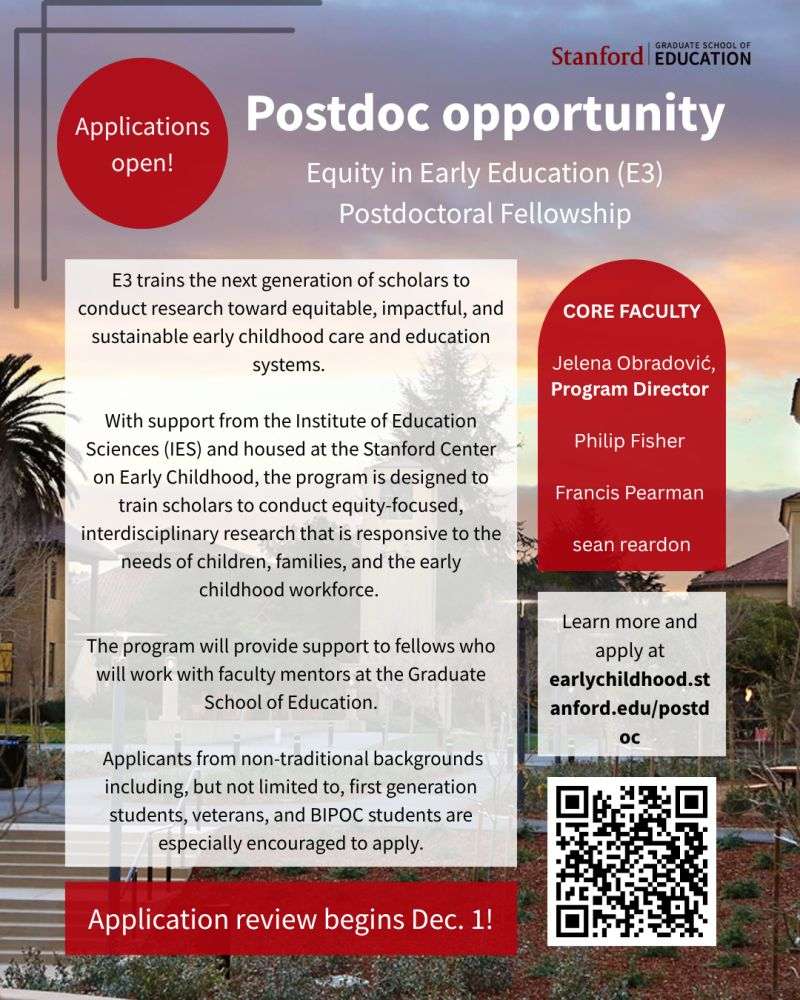
The Equity in Early Education (E3) Postdoctoral Fellowship Program at Stanford University represents a pioneering initiative dedicated to preparing the next generation of scholars to lead equitable transformations in early childhood care and education (ECCE).
Hosted by the Stanford Center on Early Childhood (SCEC) and funded by the U.S. Department of Education’s Institute of Education Sciences (IES) under grant number R305B220018, this fellowship aims to cultivate a community of emerging researchers who are deeply committed to dismantling systemic racial and economic inequities affecting young children and their families.
Through a blend of rigorous academic training, community engagement, and interdisciplinary collaboration, the E3 Fellowship provides scholars with the knowledge, tools, and partnerships needed to conduct research that is not only scientifically sound but also socially responsive and policy-relevant.
Over a two-year period, fellows will work closely with world-renowned faculty mentors across the Stanford Graduate School of Education (GSE) and the Stanford School of Medicine, gaining hands-on experience in collaborative research-practice partnerships that connect scientific inquiry with real-world change.
Program Vision and Purpose
Why Equity in Early Education Matters
The early years of life represent a critical period of human development — shaping the cognitive, emotional, and social foundations upon which lifelong outcomes are built. Yet, persistent disparities in access to high-quality early education and care continue to reinforce cycles of racial, social, and economic inequality.
The E3 Fellowship recognizes that traditional research approaches alone are insufficient to address these structural inequities. Building equitable early childhood systems requires scholars who can integrate multiple disciplines, partner with communities, and translate evidence into actionable practice.
By training scholars to conduct research that is equity-focused, interdisciplinary, and responsive to community needs, the program seeks to establish a new model of research leadership — one grounded in collaboration, innovation, and social justice.
Program Philosophy and Core Values
The E3 Fellowship is built around three guiding principles:
1. Equity-Focused Research
Fellows are trained to conceptualize and pursue research questions that center systemic equity as both a process and an outcome. The fellowship encourages scholars to investigate how structural racism, poverty, and policy frameworks shape developmental trajectories — and to identify pathways toward equitable reform.
2. Interdisciplinary Inquiry
Recognizing that early childhood development exists at the intersection of multiple systems — including education, health, economics, and family dynamics — the program draws from diverse theoretical and methodological traditions. Fellows engage in cross-disciplinary training, integrating insights from developmental psychology, sociology, education policy, data science, and public health.
3. Responsiveness to Stakeholders
E3 Fellows are expected to co-create research with educators, families, policymakers, and community partners. This participatory approach ensures that scientific knowledge reflects the lived realities of those most affected by inequities — and that research findings are translated into practical, sustainable solutions.
Apply Here!
Program Structure and Training Components
The E3 Fellowship spans two years, offering comprehensive academic and professional development opportunities tailored to each fellow’s background and goals.
Faculty Mentorship and Collaboration
Fellows receive close mentorship from four core faculty members within the Stanford Graduate School of Education, as well as two affiliated faculty members from the Stanford School of Medicine. Together, this team provides a dynamic, interdisciplinary learning environment that integrates educational, psychological, and medical perspectives on child development.
Core Faculty Mentors
- Dr. Jelena Obradović, Program Director – Graduate School of Education
- Dr. Philip Fisher – Graduate School of Education
- Dr. Francis Pearman – Graduate School of Education
- Dr. Sean Reardon – Graduate School of Education
Affiliated Faculty
- Dr. Lisa Chamberlain – Stanford School of Medicine
- Dr. Ryan Padrez – Stanford School of Medicine
These mentors guide fellows in designing, implementing, and disseminating cutting-edge research projects, providing individualized feedback and career development support.
Research-Practice Partnerships
A defining feature of the E3 Fellowship is its emphasis on collaboration with community organizations and education systems. Fellows work on active faculty-led projects embedded within long-standing partnerships that bridge research and practice.
Through these collaborations, fellows gain experience in:
- Identifying pressing community and policy questions
- Designing and implementing pragmatic studies
- Conducting mixed-methods analyses
- Disseminating findings to both academic and practitioner audiences
This structure ensures that fellows’ research contributes directly to the development of effective and equitable practices in early childhood education.
Research Themes and Projects
Fellows will have the opportunity to engage in ongoing studies that address key questions such as:
- How disparities in early childhood care and education opportunities affect developmental outcomes
- How ECCE practices and policies produce heterogeneous effects across populations
- How children’s and caregivers’ identities, contexts, and experiences shape learning trajectories
- How developmental outcomes can be conceptualized and assessed in ways that honor cultural diversity and equity
Each fellow’s project is designed to contribute to a broader understanding of how systems can be restructured to promote justice, inclusion, and opportunity for all young learners.
Professional Development and Skill-Building
Beyond research, the E3 Fellowship emphasizes comprehensive professional training to prepare scholars for impactful academic and policy-oriented careers.
Academic and Research Training
Fellows participate in specialized workshops, seminars, and courses aimed at strengthening their research competencies. These include:
- Quantitative and Mixed Methods Analysis – Offered through the Education Data Science Program and the Center for Education Policy Analysis
- Cultural Competency and Equity Studies – Through the Race, Inequality, and Language in Education (RILE) program and the Learning Differences and Future of Special Education initiative
- Partnership Research – Through courses and experiences connected to Stanford’s Certificate Program in Partnership Research
Communication and Dissemination
The fellowship also trains scholars to communicate their findings beyond academia — including policymakers, educators, and the public. Fellows receive support in:
- Academic writing and peer-reviewed publishing
- Policy brief and grant proposal development
- Public communication and media engagement
Career and Leadership Development
Through mentorship and networking opportunities, fellows learn effective strategies for:
- Navigating the academic job market
- Building interdisciplinary research teams
- Securing funding for equity-centered projects
- Leading collaborations that integrate research and practice
Eligibility and Ideal Candidate Profile
The E3 Fellowship seeks outstanding scholars whose research and lived experiences demonstrate a commitment to advancing equity in early childhood systems.
Required Qualifications
Applicants must:
- Hold a Ph.D. or Ed.D. in education, developmental psychology, economics, sociology, or a closely related discipline, conferred within two years of the application date
- Demonstrate proficiency in quantitative or mixed-methods research, with a dissertation or published work focused on equity-related themes
- Exhibit a strong desire to expand their methodological, analytical, and applied skills
- Be U.S. citizens or permanent residents (as required by federal funding regulations)
- Be in residence in the Bay Area during the fellowship period
Ideal Candidate Profiles
The program welcomes diverse applicants, including those who:
- Have significant community or practitioner-based experience but seek more rigorous quantitative training
- Have strong disciplinary or statistical skills but limited exposure to applied, partnership-based research
- Identify as first-generation scholars, veterans, or BIPOC researchers
- Are motivated to apply research as a tool for systemic transformation in early education
The E3 Fellowship values applicants who are curious, collaborative, and committed to bridging theory and practice in pursuit of educational justice.
Apply Here!
Fellowship Benefits and Opportunities
E3 Fellows receive:
- Two years of full financial support, including stipend, research funds, and professional development resources
- Access to Stanford’s world-class research infrastructure, including libraries, labs, and data centers
- Participation in interdisciplinary events such as seminars, workshops, and speaker series
- Mentorship from distinguished faculty and engagement with cross-campus initiatives
- Networking opportunities with policymakers, practitioners, and community leaders
In addition, fellows join a growing network of scholars and alumni dedicated to advancing equitable early learning systems across the nation.
Impact and Broader Significance
The Equity in Early Education Fellowship is more than a training opportunity — it is a national investment in the future of inclusive, evidence-driven education systems.
By supporting researchers who work at the intersection of science, community, and justice, the program contributes to:
- Generating data that informs equitable policy and practice
- Building bridges between academia and early learning practitioners
- Expanding the visibility and influence of historically marginalized voices in research
- Strengthening the pipeline of leaders committed to early childhood equity
Ultimately, the E3 Fellowship reflects Stanford University’s enduring mission: to advance knowledge that benefits humanity through discovery, collaboration, and service.
Location and Institutional Support
The program is housed at the Stanford Center on Early Childhood, part of the Stanford Graduate School of Education. The Center serves as a hub for interdisciplinary collaboration, supporting research, innovation, and policy engagement that enhance the lives of young children and their families.
Address:
Stanford Center on Early Childhood
520 Galvez Mall, CERAS 407
Stanford University
Stanford, CA 94305, United States
Contact:
Call: (650) 724-4678
Email:earlychildhood@stanford.edu
Fellows will work in close connection with the Graduate School of Education, the School of Medicine, and other research initiatives across campus, benefitting from the university’s vibrant intellectual ecosystem.
Application Process
Timeline and Submission
Applications are typically accepted once per year, with fellowship terms lasting two years. Candidates must have completed their doctoral degree before the start of the program.
Interested applicants are encouraged to review the official application portal and prepare the following materials:
- Curriculum Vitae (CV)
- Research Statement outlining scholarly interests, equity focus, and alignment with E3 themes
- Writing sample (dissertation chapter or published paper)
- Three academic references
- Optional: Diversity or community engagement statement
Shortlisted candidates may be invited to an interview with program faculty.
Evaluation Criteria
Selection committees assess applicants based on:
- Academic excellence and methodological rigor
- Demonstrated commitment to equity and applied research
- Alignment with program objectives and faculty expertise
- Potential for leadership and impact in early childhood systems
Inaugural Cohort and Legacy
The inaugural E3 Fellows represent a diverse and dynamic group of emerging scholars whose work embodies the program’s mission to bridge research and social change. Their projects span areas such as:
- Racial equity in early learning environments
- Socioeconomic disparities in access to ECCE programs
- Developmental assessment frameworks for culturally diverse populations
- Family engagement and policy advocacy
Through their contributions, the E3 Fellowship continues to expand the boundaries of what is possible in early education research.
Apply Here!
Conclusion
The Equity in Early Education (E3) Postdoctoral Fellowship at Stanford University stands as a model for how higher education institutions can integrate scientific excellence with social responsibility.
By investing in scholars who are both methodologically rigorous and community-oriented, the program seeks to transform how the United States understands and supports its youngest learners.
E3 Fellows emerge not only as researchers but as changemakers — ready to design and lead the next generation of equitable, evidence-based policies and practices that ensure every child has the opportunity to thrive.
For more opportunities, visit: opportunitiesforwomen.org/







Comments are off for this post.