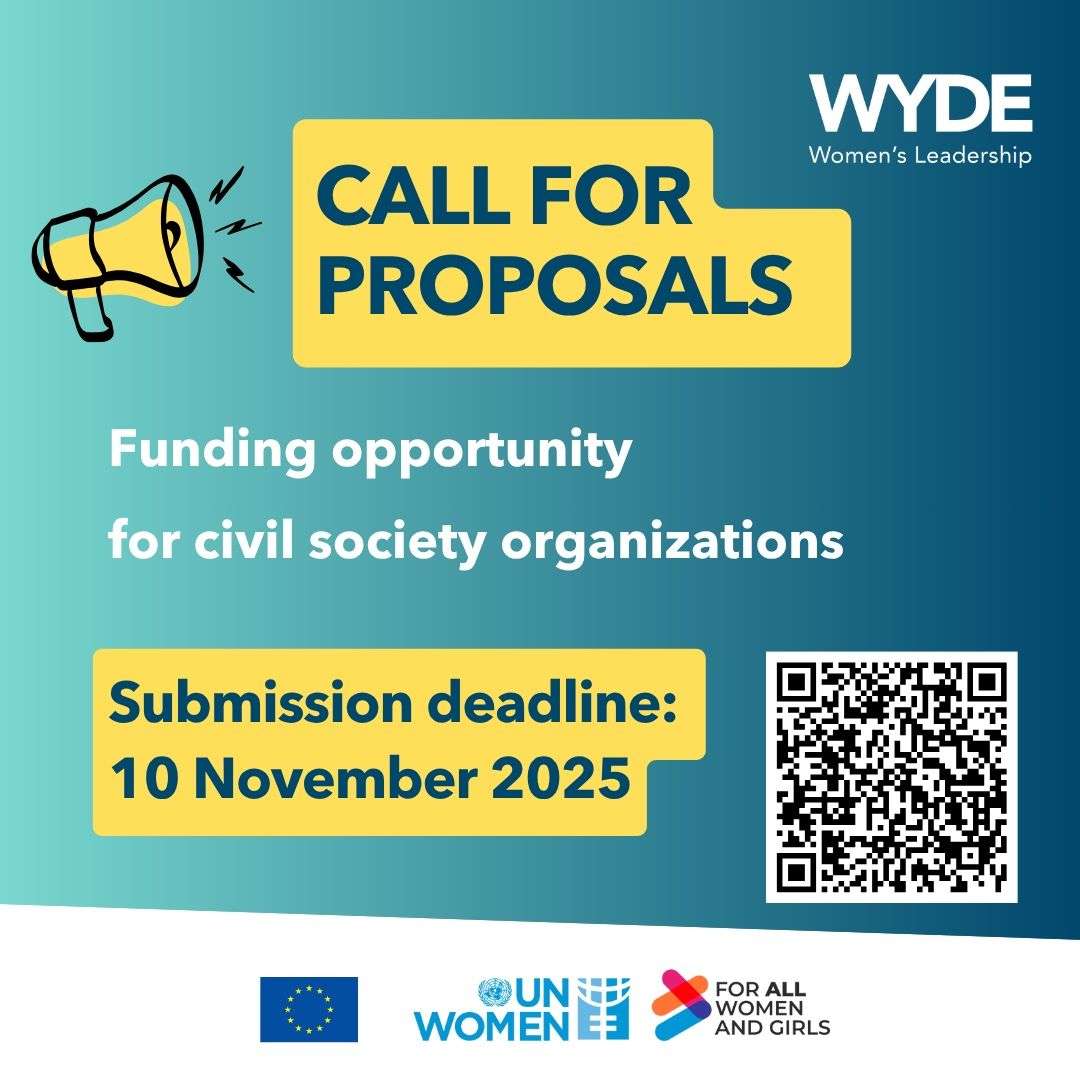
Deadline: 10 November 2025, 23:59 EDT (New York)
CFP ID: UNW-HQ-WPP-CFP-2025-001
Funding per award: USD 45,000 – 150,000
Project length: 12–22 months (agreements signed by 28 February 2026; all projects end by 31 December 2027)
Total envelope: ~USD 1,000,000
Eligible applicants: Civil Society & Women’s Rights Organizations (including youth-led)
Overview
UN Women—under the WYDE | Women’s Leadership initiative funded by the European Union—invites proposals from civil society and women’s rights organizations to advance women’s full and effective political participation and decision-making at all levels. This round focuses on social norms change, intergenerational and intersectional leadership, and movement building aligned with the Generation Equality Action Coalition on Feminist Movements & Leadership (AC6).
Despite decades of progress, women—especially young women and those facing intersecting forms of discrimination—remain underrepresented in public life. This call backs organizations that are changing narratives, strengthening leadership pipelines, and mobilizing feminist movements so that women are recognized as equally legitimate political actors.
What This Call Funds (Priority Focus Areas)
Projects should contribute to WYDE Outcome 1:
“Leadership and networking of women in public life are strengthened, including through existing dialogue mechanisms, at global, regional, and local levels.”
Eligible strategies include (choose one or combine, as relevant to your context):
-
Build Women’s Political Leadership Capacity
Develop/adapt training, leadership academies, toolkits, or methodologies—especially for underserved groups (e.g., women with disabilities, Indigenous women, LGBTQI+ women).
-
Mentorship & Intergenerational Networks
Pair emerging and youth leaders (18–35) with seasoned advocates; equip them for collective action, advocacy, and coalition building (including smart use of digital tools).
-
Social Norms & Narrative Change
Engage men and boys, media, and community leaders; address gendered disinformation; run evidence-based campaigns that shift attitudes and reduce violence against women in public life.
-
Feminist Movement Strengthening
Lead consortia and sub-partnerships that expand networks, share knowledge, and build organizational capacity across movements.
-
Increase Women’s Access to Decision-Making
Advocate for structural reforms; create evidence (e.g., baseline/perception studies); open channels for consultation on policies and legislation.
Tip: Proposals that sub-partner (especially with youth-led and constituency-led organizations) are prioritized.
Who Should Apply
Mandatory eligibility (pass/fail):
-
Legally registered non-governmental organization.
-
3+ years experience in women’s leadership/political participation/human rights/movement building (5+ years preferred for larger awards).
-
Audited financial statements for the last 3 years.
-
Single-country implementation in a country eligible for Official Development Assistance (ODA).
-
Acceptance of UN Women Partner Agreement terms, and compliance with Anti-Fraud and PSEA (Protection from Sexual Exploitation and Abuse) standards.
-
Not sanctioned; no disqualifying findings or ongoing investigations.
Prioritization criteria (competitive):
-
Core mandate in women’s rights and gender equality.
-
Africa-based projects prioritized.
-
Youth-led organizations (≥51% of leadership aged 18–35) and organizations serving marginalized groups (e.g., led by women with disabilities, Indigenous women, LGBTQI+ women).
-
Demonstrated success in social norms change, coalition building, and operating in shrinking civic spaces.
EU exclusionary criteria apply (e.g., fraud/corruption, terrorist offences, grave professional misconduct, tax/social security breaches, etc.).
Key Dates (2025–2027)
-
Clarification requests due: 20 October 2025 and 27 October 2025 (by 23:59 EDT)
-
UN Women responses issued: 27 October 2025 and 5 November 2025 (by 23:59 EDT)
-
Proposal deadline: 10 November 2025, 23:59 EDT
-
Planned contract start/signing: By 28 February 2026
-
Implementation window: After signing through 31 December 2027
Where to send questions & submissions: wyde@unwomen.org (subject line should reference CFP UNW-HQ-WPP-CFP-2025-001)
Contact person: Adina Wolf (WYDE[at]unwomen.org)
Budget & Allowable Costs
-
Grant size: USD 45,000 – 150,000 (proposals over the cap will be rejected).
-
Include realistic, results-based budgets; personnel costs generally ≤20% of programming; M&E ~3%; audit 3–5% (retained by UN Women); support/overhead ≤7% (or lower if donor-specific).
-
Budget for sub-partner capacity building where applicable.
How to Apply (What Your Submission Must Include)
Use the UN Women templates. Your email must include the completed documents below (as attachments). Incomplete submissions are ineligible.
Section 1 – Mandatory documents to return:
-
CFP Letter for Responsible Parties
-
Proposal Data Sheet
-
UN Women Terms of Reference (acknowledged)
-
Acceptance of Partner Agreement terms (note any reservations)
-
Annex B-1: Mandatory Requirements / Pre-Qualification
-
Annex B-4: Capacity Assessment Minimum Documents (governance, PSEA/SEA training evidence, anti-fraud policy, audited accounts, procurement policies, client references, etc.)
Section 2 – Instructions & templates to complete:
Submission method: One email with all required attachments to wyde@unwomen.org by 10 November 2025, 23:59 EDT. The inbox timestamp is the official receipt time.
What Reviewers Look For (Scoring Snapshot)
Phase I – Technical (70 points, min. 50 to pass):
-
Compliance with CFP requirements (15)
-
Organizational mandate & relevance (20)
-
Quality & feasibility of approach, results framework, M&E, partnership plan, risk management (35)
Phase II – Financial (30 points):
Strong Proposal Checklist (SEO-friendly quick wins)
-
Clear Outcome 1 alignment, with SMART indicators and verifiable baselines.
-
A country-specific social norms strategy. Cite evidence or past pilots.
-
Consortium approach with youth-led/constituency-led sub-partners and a capacity-strengthening plan.
-
Safety, PSEA, and safeguarding integrated in design, training, and reporting.
-
Do-no-harm and online/offline disinformation response tactics.
-
Budget that matches activities, no cost padding, and reasonable overheads.
-
Realistic timeline to deliver results within 12–22 months.
Frequently Asked Questions
1) Can we propose a regional/multi-country project?
No. Single-country proposals only (country must be ODA-eligible).
2) Are youth-led organizations eligible as leads?
Yes—and prioritized (≥51% of leadership aged 18–35).
3) Do we need sub-partners?
While not mandatory, consortia and sub-partnerships (especially constituency-led groups) are strongly encouraged and prioritized.
4) What kinds of costs are NOT competitive?
Inflated personnel/overheads, activities without direct links to outputs/outcomes, and costs not aligned with the results framework.
5) Can we include research?
Yes—if it informs social norms change, leadership pathways, and policy engagement (e.g., perception surveys, baselines).
Source: https://www.unwomen.org/en/programme-implementation/2025/10/unw-hq-wpp-cfp-2025-001-wyde-women-leadership





Comments are off for this post.