

Let the people have a say
Empowering women is a critical part of building a thriving and sustainable society. As emphasised by the World Bank Group (2024, p. ix), “Gender equality is a matter of fairness and justice, and it is also essential for development.”
While Burkina Faso has taken steps to advance gender equality through national frameworks and commitments, significant disparities persist, particularly in women’s political representation and leadership. This reflects a broader global trend identified by UN Women (2024), which notes that gender gaps in power and opportunity remain widespread. Burkina Faso’s ranking of 120th out of 146 countries in the World Economic Forum‘s (2024) Global Gender Gap Index highlights the extent of these challenges and the barriers that gender inequality poses to the country’s development (Karambiri et al., 2024).
The government of Burkina Faso has stated its commitment to the United Nations Sustainable Development Goals (SDGs), whose Goal No. 5 calls for achieving gender equality and empowering all women and girls. The government’s National Gender Strategy 2020-2024 aims at empowering women and girls while promoting equity at central, local, and community levels, and the Integrated Programme for Women’s Empowerment in Burkina Faso tackles disparities by enhancing women’s economic, political, and social opportunities (Burkina Faso, 2022). A gender quota law mandates that at least 30% of candidates on electoral lists must be women, aiming to increase their representation in Parliament (Assemblée Nationale, 2020). However, in 2025 only 18.3% of the members of the Transitional Legislative Assembly in Burkina Faso are women (Interparliamentary Union, 2025).
This dispatch reports on a special survey module included in the Afrobarometer Round 9 (2021/2023) questionnaire to explore Africans’ experiences and perceptions of gender equality in control over assets, hiring, landownership, and political leadership.
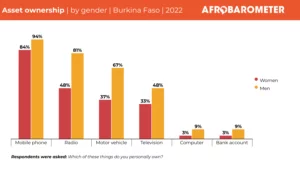
In Burkina Faso, educational attainment is close to gender-equal, but women trail men in ownership of key assets and in financial autonomy. Strong majorities express support for equal rights for women in hiring, landownership, and political leadership, although men are less supportive of equality than women.
In practice, only a minority assert that women enjoy equal rights when it comes to owning or inheriting land. And a sizable majority of citizens consider it likely that women who run for public office will suffer criticism or harassment.
Overall, a majority of Burkinabè approve of the government’s performance in promoting equal rights and opportunities for women but say greater efforts are needed.
Marcelline Amouzou is a PhD student in political science at the University of Florida.
Related content
Receive the latest updates from Afrobarometer