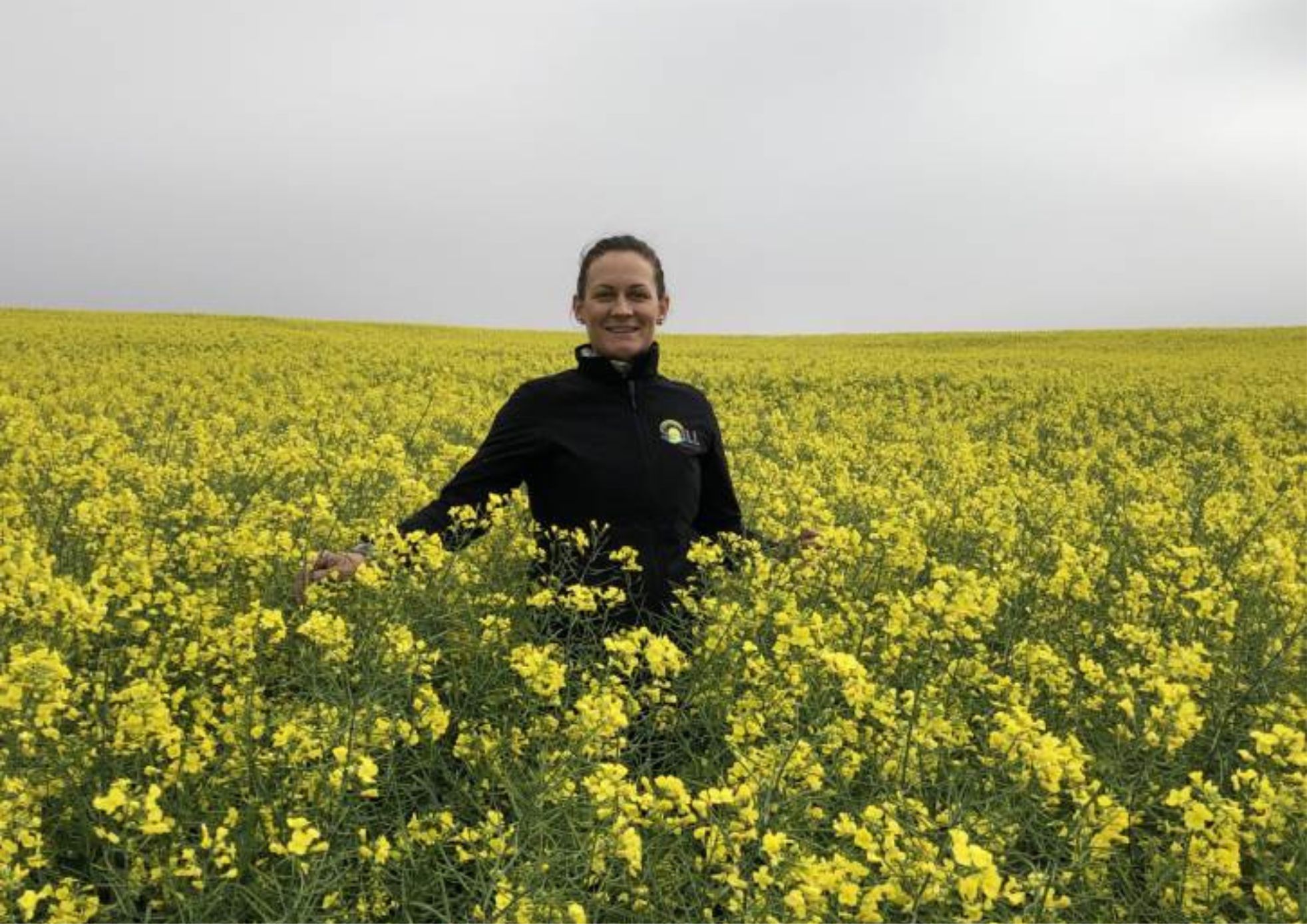
Dr Izane Crous is an agricultural scientist at Omnia Holdings. Supplied/Food For Mzansi
Despite growing opportunities for women in agriculture, many remain confined to small-scale farming roles, unable to break into commercial or technical positions. This reflects a broader global challenge around female advancement in the sector, says Dr Izane Crous, agricultural scientist at Omnia Holdings.
According to the World Bank, the agricultural economy employs 65 – 70% of Africa’s labour force and, on average,e accounts for 30 – 40% of GDP. In developing nations, women are believed to make up 43% of this agricultural workforce.
Yet, the barriers many women face in the sector limit their productivity, hinder their full contribution, and hold back the industry from reaching its full potential across the continent.
According to Crous, in South Africa, the census report found that of the 40 000 commercial farms (classified as those registered for VAT, with a turnover of R1 million per year), only 20% are owned by women.
“This underscores the global issue of female advancement, where most female participants are bound to small-scale farming roles and cannot overcome barriers to reach commercial level,” says Crous.
She highlights that there are many roles available for women in the sector, but women need to be empowered to achieve them.
“From agricultural economist to agricultural educator, there are a range of new and evolving career paths for women in agriculture outside of farm ownership or labour, both globally and in Africa.”
She adds that by way of example, the development and implementation of technology-driven solutions for efficient crop management has become popular, and with this there has been an increase in the demand for roles such as precision agriculture specialist, agricultural research scientist, food scientist and food safety specialist.
What is preventing the mobilisation of women into these roles? According to Crous, social and cultural norms are some of the biggest challenges women working in the agricultural industry may face.
“Women face a complex set of societal, cultural and economic challenges. Access to farm ownership is limited and may be complicated by gendered approaches to inheritance in certain cultures.
“Additionally, there are fewer opportunities for education and knowledge building as well as the societal issue of lower wages for females.
“In addition, we see an increased risk for women farmers of physical health complications such as injuries or ergonomic strain due to heavy manual labour, lack of protective equipment, long hours on the road, and rendering of services in dangerous areas,” Crous explains.
Household responsibilities also typically fall on females, Crous adds, and women are generally expected to prioritise domestic and childcare responsibilities, as well as sometimes the care of older relatives, over agricultural work.
This creates a substantially greater workload, which is not compensated economically, says Crous. “All these challenges compound to create a complex maze of barriers for women in the space to navigate.”
Crous believes that supporting and enabling the contribution of women in the sector is not only critical for the financial inclusion of women on the continent but for its food security too.
With the global population projected to reach a staggering 10 billion by 2050, building a sustainable global food and water system is critical, and women have a key role to play here.
“From a small farm perspective, OXFAM says that growth in small-scale agriculture is two to four times more effective at reducing hunger and poverty than any other sector. Female farmers are central to this as their subsistence efforts provide large amounts of food for families and communities across the continent,” says Crous.
Women bring unique skills, perspectives and experiences to the agricultural industry.
“Anecdotally, women tend to be more detail-orientated, which is highly favoured in the agricultural advisory and research industry. Women also often possess excellent communication skills, which facilitates the clear and efficient exchange of ideas, concerns and needs.
“I have also experienced females in the industry demonstrating remarkable resilience in the face of challenges, using creative problem-solving skills to overcome challenges.”
She adds that this drives innovation and creativity in the agricultural workplace. Furthermore, Crous believes that a diverse workplace fosters a culture of inclusion, empathy and respect, leading to more inclusive decision-making and problem-solving.
Crous concludes that the benefits of supporting women in agriculture will be far-reaching.
“By empowering women in agriculture, not only will Africa get its seat at the table in terms of agricultural contribution, but the social and economic benefits for our continent and its people can be broadened to increase women empowerment, reduce gender inequality, and improve education and health outcomes.”
READ NEXT: From cleaner to champion: SA Dairy Awards honours Dzindikwa
Sign up for Mzansi Today: Your daily take on the news and happenings from the agriculture value chain.
DUNCAN MASIWA is the assistant editor at Food For Mzansi, South Africa’s leading digital agriculture news publication. He cut his teeth in community newspapers, writing columns for Helderberg Gazette, a Media24 publication. Today, he leads a team of journalists who strive to set the agricultural news agenda. Besides being a journalist, he is also a television presenter, podcaster and performance poet who has shared stages with leading gospel artists.
Beat the festive season price hikes! By supporting Mzansi’s farmers and making homemade treats, you can keep your family fed…
THE NEW FACE OF SOUTH AFRICAN AGRICULTURE
With 21 global awards in the first six years of its existence, Food For Mzansi is much more than an agriculture publication. It is a movement, unashamedly saluting the unsung heroes of South African agriculture. We believe in the power of agriculture to promote nation building and social cohesion by telling stories that are often overlooked by broader society.
Contact us
Office: +27 21 879 1824
News: info@foodformzansi.co.za
Advertising: sales@foodformzansi.co.za
Contact us
Office: +27 21 879 1824
News: info@foodformzansi.co.za
Advertising: sales@foodformzansi.co.za
Copyright © 2024 Food for Mzansi
source







No Comments