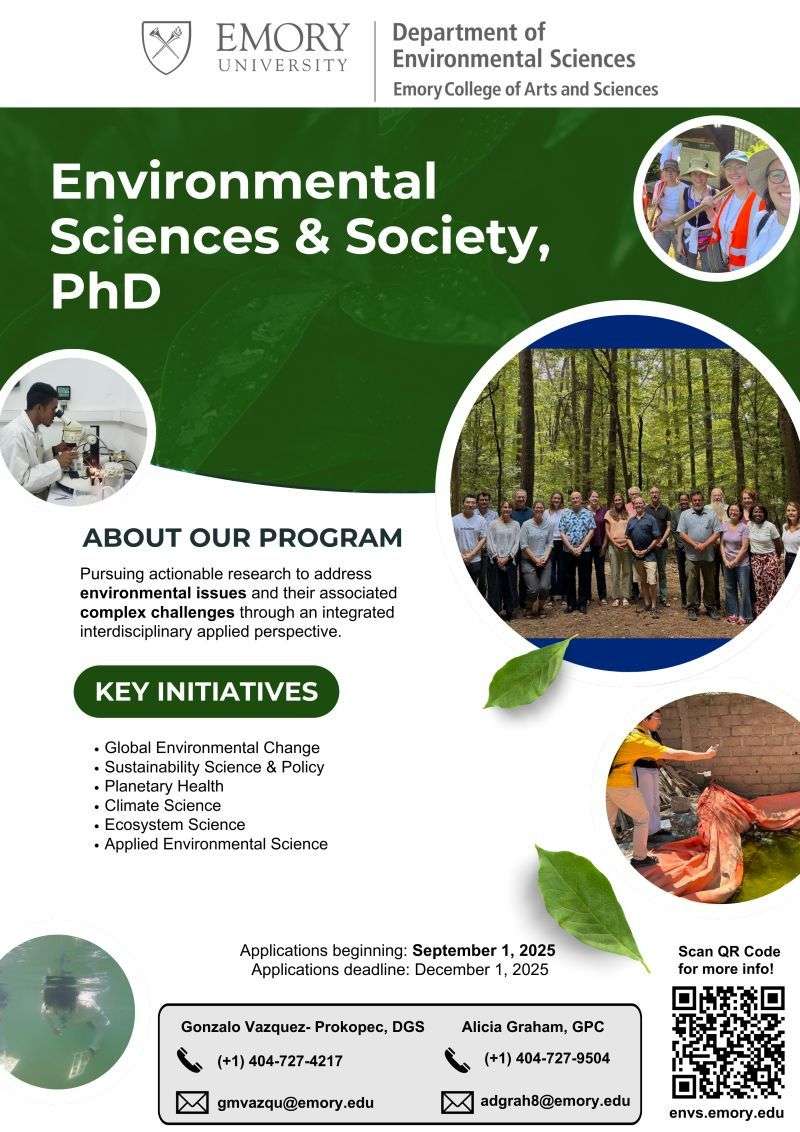
Emory University’s Laney Graduate School offers fully funded doctoral opportunities in Environmental Sciences & Society (ESS). This interdisciplinary program combines applied natural and social sciences to address urgent environmental challenges through actionable research and experiential cross-training.
About the Environmental Sciences and Society Program
The ESS program conducts interdisciplinary research that tackles environmental issues and their associated complex challenges through an integrated applied perspective. Through co-mentoring and experiential cross-training, students pursue research designed to create real-world solutions to pressing environmental problems.
Core Research Themes
Climate Change, Environmental Health, and Justice
This research area explores the intersection of climate risks, air quality, and social inequities. The focus centers on developing adaptation solutions that promote justice and resilience in vulnerable communities. Research includes analyzing the socio-political dimensions of urban disasters, climate migration, air pollution, and emissions reduction strategies, with particular emphasis on equitable transitions.
Sustainable Ecosystem Management
This theme investigates how human activities impact ecosystems, from agriculture to urban environments, with a focus on sustainable practices. Ongoing projects explore the impacts of land use changes on ecosystem services and biodiversity, as well as policy strategies for promoting sustainable agriculture and urban green infrastructure.
Biodiversity and Disease Ecology
This research explores the interactions between environmental change and species health. Faculty and students examine how environmental shifts and management affect species interactions, invasive species ecology, and the emergence of zoonotic diseases in the context of global health.
Research Methods
The program employs combined methodological approaches that allow for deeper understanding and synthesis of environmental and social systems:
Geospatial Analysis and Remote Sensing
Researchers use geographic information systems (GIS) and remote sensing to model land use, climate impacts, and air quality, as well as ecological dynamics at various scales, from local to global.
Epidemiological, Ecological, and Emissions Modeling
The program employs advanced modeling techniques to understand disease transmission, species interactions, emissions sources, and ecosystem processes. These methods inform conservation strategies, public health interventions, and climate mitigation policies.
Social Science Research Methods
The program incorporates qualitative and quantitative approaches, including surveys, interviews, and ethnographic studies, to understand community perceptions, values, and behaviors related to environmental issues.
Participatory Research and Community Engagement
The program emphasizes community-based participatory research, working closely with local communities, Indigenous groups, and stakeholders to co-develop sustainable solutions tailored to the social and ecological contexts of diverse regions.
By integrating environmental and social sciences, the program empowers graduates to effectively confront urgent environmental challenges, fostering innovative solutions that promote sustainability and justice across diverse communities.
Important Dates
Applications Open: September 1, 2025
Application Deadline: December 1, 2025 (midnight U.S. Eastern Time)
Application Materials Required
Documents for Upload
Applicants need to prepare several files for their application:
- Resume or Curriculum Vitae (CV): Documentation of educational background, work experience, and accomplishments
- Statement of Purpose: An essay explaining academic interests, career goals, and motivation for graduate study
- Transcripts: Scanned copies of academic transcripts from all previously attended institutions
- Writing Sample: Required by certain programs to demonstrate research capabilities
The system accepts .pdf, .doc, .docx, .txt, .rtf, .jpg, and .tif file formats.
Programs requiring test scores benefit from applicants providing registration numbers for:
- GRE (Graduate Record Examination)
- GMAT (Graduate Management Admission Test) where applicable
- TOEFL (Test of English as a Foreign Language) for international applicants
Applicants can proceed even if they’ve registered for tests but haven’t yet received scores.
Contact details needed for letter of recommendation writers include:
- Email addresses
- Institutional affiliation or professional organization
Application System Features
The online application allows applicants to save partial progress and return later. Support resources and the Applyweb Helpline are accessible throughout the process.
Application Requirements
Standard Requirements
The Laney Graduate School has baseline requirements for all programs, available on the Requirements page.
Individual programs may have additional requirements beyond standard school requirements. Each program’s website contains information about:
- Supplementary materials
- Specialized prerequisites
- Program-specific deadlines
The Program Admissions Requirements page links to individual program sites.
Application Fee
The application fee is $75, paid by credit card through the online system. This fee is non-refundable.
Fee Waivers
Limited fee waivers are available for:
- Participants in programs designed to prepare students for graduate study
- Applicants demonstrating financial hardship
Information about eligibility and the waiver process is on the Application Fee Waivers page.
Academic Integrity Policy
Emory University expects admitted students to uphold the institution’s intellectual, ethical, and professional standards. Application materials are subject to standards of academic honesty and integrity.
The Laney Graduate School reserves the right to rescind admission offers when applicants are found to have presented misleading or fraudulent information during the application process, and for other reasons as determined by the school.
For more information, visit their website here
Stay on opportunitiesforwomen.org/ for more opportunities





Comments are off for this post.